



You've found a Die Hard poster online, or perhaps one has been rolled up in a cupboard for years. The artwork looks familiar, but the title alone won't tell you whether it's a first-release British cinema poster, a later campaign piece, or a reproduction. Start with format and release date, then judge condition and price separately.
Table of Contents
- Die Hard Movie Posters at a Glance
- Why the Quad and the One Sheet Are Not Interchangeable
- How to Date and Authenticate a Die Hard Poster
- What Die Hard Posters Sell For
- Folds, Restoration and What to Leave Alone
- Storing, Framing and Displaying Your Poster
- Choosing Your First Die Hard Poster
Die Hard Movie Posters at a Glance
A UK cinema poster can be dated more reliably by the film's classification history than by its artwork alone. The BBFC recorded Die Hard’s cinema classification on 8 August 1988, naming 20th Century Fox Film Co. Ltd. as distributor. This anchors the British theatrical release to 1988 (BBFC classification record).
The UK Quad format measures 30 × 40 inches (76.2 × 101.6 cm) and is horizontally oriented. A documented example is single-sided, with the tagline “40 Storeys High” and artwork showing Bruce Willis as John McClane, Nakatomi Plaza and a helicopter above Los Angeles. Check these details against the sheet in front of you; a high asking price or a seller's rarity label does not establish that it is original or rare.
| Format | Size | Orientation | Release year | Notes |
|---|---|---|---|---|
| UK Quad, theatrical | 30 × 40 in (76.2 × 101.6 cm) | Landscape | 1988 | UK cinema campaign; “40 Storeys High” tagline |
| US One Sheet | About 27 × 41 in | Portrait | 1988 | US cinema format; compare size and artwork with a UK sheet |
| British One Sheet | 27 × 40 in | Portrait | Not established here | Check the sheet's measurements and orientation |
| Re-release material | Not established here | Not established here | 2008 or 2013 | Later campaign material, not a 1988 item |
| Die Hard with a Vengeance UK Quad | 30 × 40 in | Landscape | 1995 | Poster for a different film in the series |
| Die Hard 2 concept artwork | Not established here | Not established here | c. 1990 | Listed in Sotheby's 2025 Original Film Posters catalogue |
Use the table to identify the format and film before assessing condition. A 30 × 40-inch sheet may be a Quad for a sequel, not the original Die Hard campaign. Folds are also common on British Quads issued for cinema use, so their presence alone does not prove a poster is damaged or authentic. Check measurements, printed details and release context together, then consider condition and price separately.
Why the Quad and the One Sheet Are Not Interchangeable
A UK Quad measures 30 × 40 inches (76.2 × 101.6 cm) and is displayed in a horizontal orientation. A US One Sheet is generally portrait-oriented and measures about 27 × 41 inches. Those differences affect how the poster fits a frame and help identify its format. The sizes and orientations are a practical starting point, not proof of a poster's date or originality.
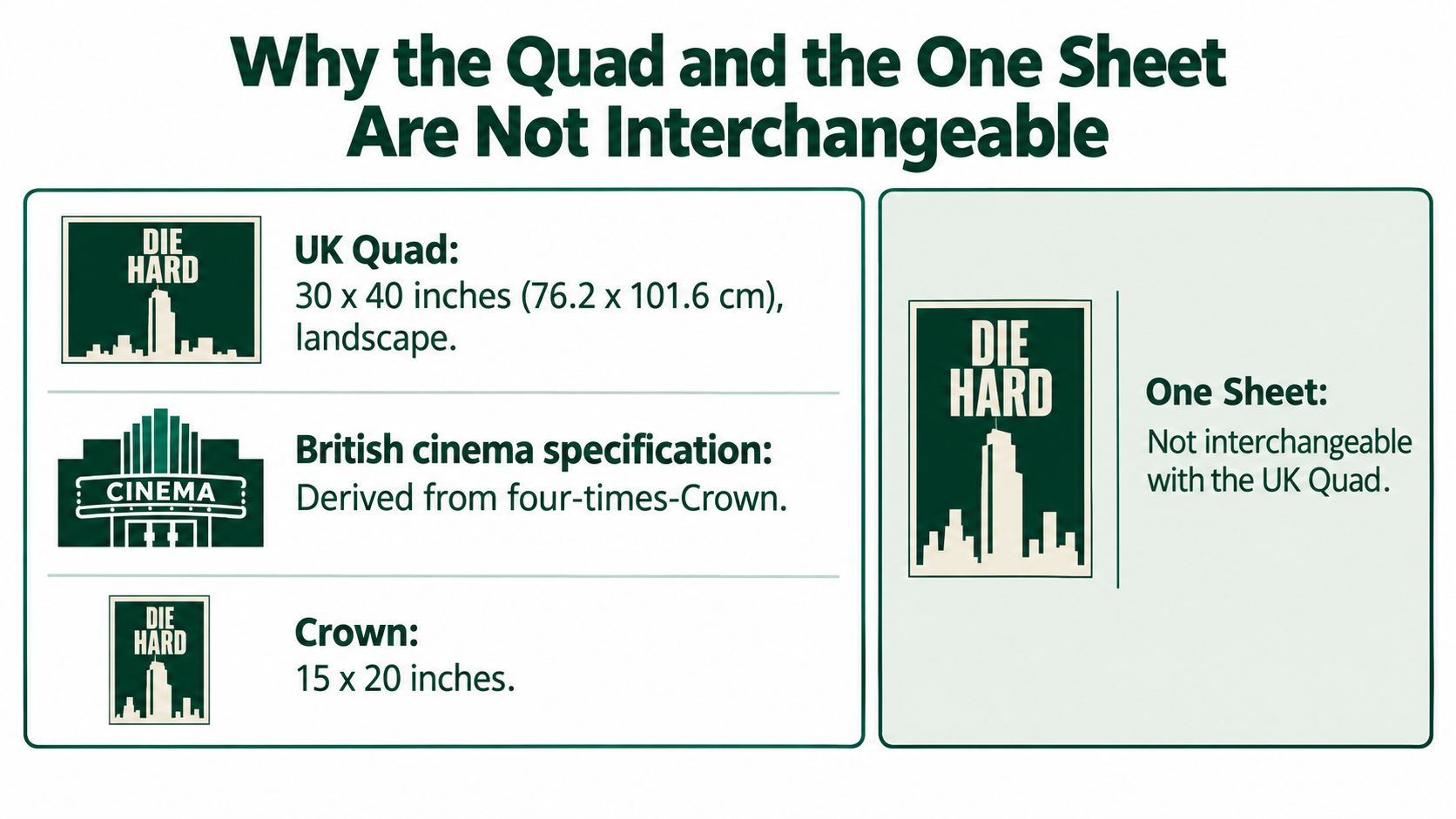
The artwork and printed credits also need checking. Compare a sheet with dated examples before deciding that its composition or distributor marks identify a particular campaign. A similar image can appear on different formats, and an asking price does not establish rarity. Separate the question of whether a poster is original from whether it is scarce.
| What to compare | UK Quad | US One Sheet |
|---|---|---|
| Orientation | Landscape | Portrait |
| Dimensions | 30 × 40 inches | About 27 × 41 inches |
| Artwork | Compare with dated British examples | Compare with dated US examples |
| Credits | Check against British campaign examples | Check against US campaign examples |
Folds are common on British Quads because they were often issued folded. Their presence alone says little about condition or value. Check the paper, fold wear and any other damage; a folded original may be in better condition than a poorly stored flat sheet.
For a fuller explanation of how One Sheets and Quads differ, start with the sheet's measurements and orientation. Check the credits against dated examples, then choose a frame that fits the full poster. The UK Quad size and format reference gives a point of comparison for its stated dimensions.
How to Date and Authenticate a Die Hard Poster
Artwork alone doesn't prove a poster is genuine. Reproductions can copy the picture well, so check the sheet itself and compare its details with the film's UK release history.
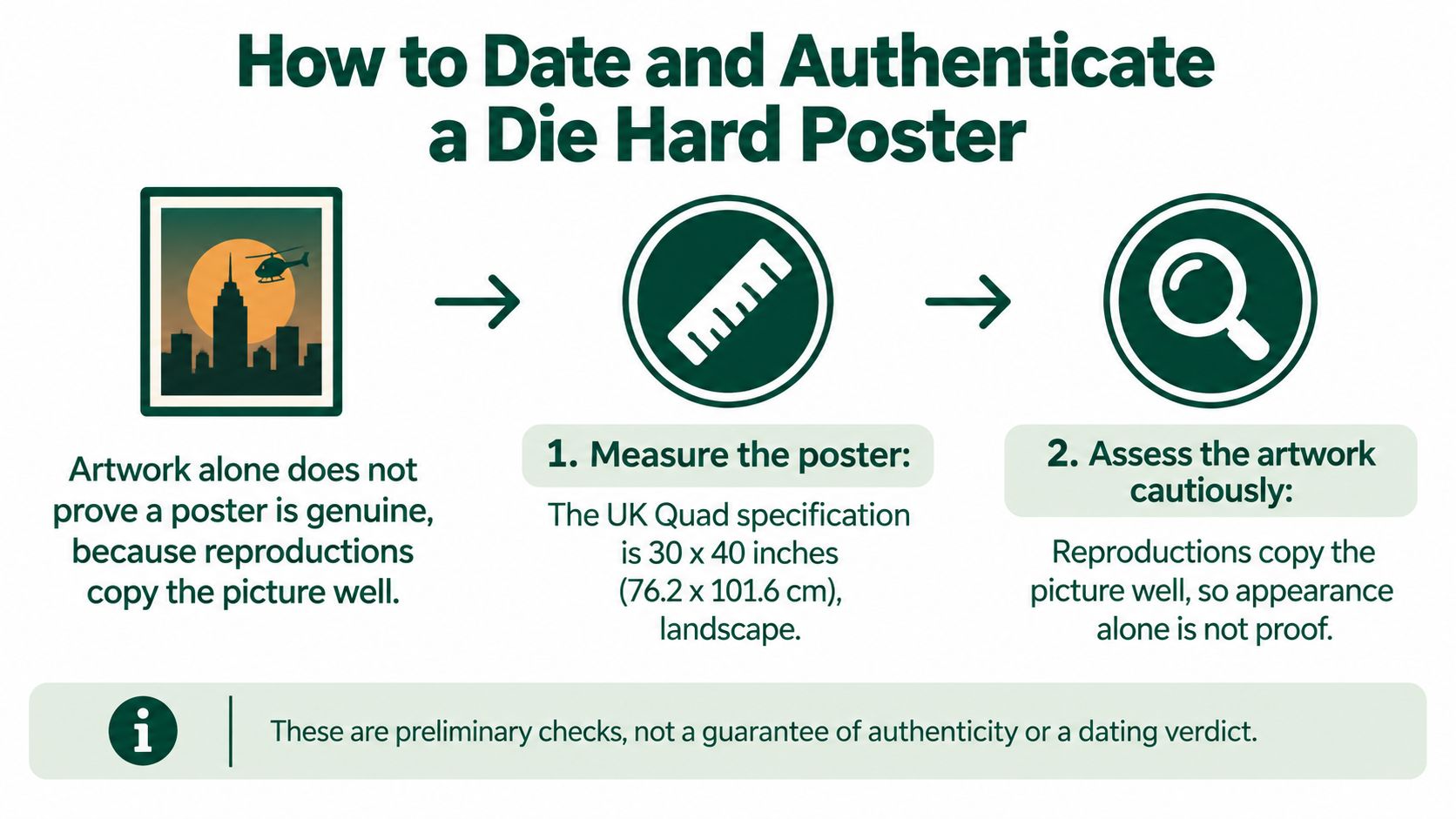
- Measure the sheet. A UK Quad should be approximately 30 × 40 inches (76.2 × 101.6 cm). Measure the paper itself, not the visible image area through a frame; dimensions that are substantially off need an explanation.
- Confirm the orientation. The UK Quad is wider than it is tall. A portrait sheet may be a US One Sheet or another format, so don't identify it as a British Quad just because the title and characters look right.
- Compare the British artwork. Look for McClane, Nakatomi Plaza, the exploding building, the helicopter over Los Angeles and the “40 Storeys High” tagline. Treat these details as a comparison, not a guarantee: a reproduction can copy the design.
- Read the credits. Inspect the printer information and distributor marks, including whether the sheet names 20th Century Fox. A later company name or different credit may indicate another campaign or format, but verify it against dated examples rather than drawing a conclusion from one mark.
- Match the date to the UK classification history. The BBFC first submitted the film for UK cinema classification in July 1988. It received an 18 cinema certificate recorded on 8 August 1988, and its UK video release remained 18 in 1989; later, the resubmission and theatrical re-release were classified 15 (BBFC case study of the classification history).
| Date | Event | Classification |
|---|---|---|
| July 1988 | First BBFC submission | Not specified |
| 8 August 1988 | Original cinema classification recorded | 18 |
| 1989 | UK video release | 18 |
| 2008 | Resubmission under revised guidance | 15 |
| 2013 | Theatrical re-release | 15 |
A sheet tied to later promotion belongs to a later campaign, even if it uses familiar imagery. For a concise overview of original British poster collecting, see this guide to original movie posters in the UK.
- Inspect paper, ink and folds. Look for cracking along fold lines, flaking ink, tears, repairs or signs of washing. Those are condition questions, not proof of age on their own.
- Compare dated references. Check at least two dated dealer or auction records, paying attention to credits, dimensions and artwork rather than relying on a loose resemblance.
- Ask for provenance. Request any purchase history, receipts or prior catalogue details, and keep the documents with the poster. If the seller claims it is an advance, ask what visible evidence supports that description.
Available information doesn't establish whether a particular 1988 Quad is an advance or a regular issue. Check printer credits and any dated advance markings against auction records and dealer archives. A sheet that fails the measurement or orientation check should be treated as a possible reprint or different format, whatever the seller calls it.
What Die Hard Posters Sell For
A British Quad can be folded, original and still modestly priced. A dealer's asking price shows what a seller hopes to receive, not what a buyer has paid. Keep those distinctions clear when comparing examples.
| Item | Source and date | Price | What it tells you |
|---|---|---|---|
| 1988 UK Quad, Die Hard | Vintage Movie Posters listing, date not stated | £495 | Dealer asking price, not a realised sale |
| Die Hard 2 concept artwork (c. 1990) | Sotheby's 2025 Original Film Posters catalogue | No price available | Catalogue entry, with no realised price provided |
The £495 figure is for a dealer-listed original 1988 UK Quad, identified as measuring 30 × 40 inches and associated with the film's British release (Vintage Movie Posters listing). The listing gives a useful reference point for an asking price. It does not show that a buyer paid £495, or establish a market value.
Sotheby's included Die Hard 2 concept artwork in its 2025 Original Film Posters catalogue, but the catalogue information cited here provides no price (Sotheby's catalogue). Artwork and a finished cinema poster are different objects, so this entry is context rather than a direct comparison with a Quad.
Original and rare are separate claims. An authentic poster may be relatively common. A scarce advance may still attract modest money if demand is limited or its condition is poor.
Compare completed auction sales with dealer listings, and record which is which. The available UK Die Hard examples are too limited to establish a recent price trend. A single high asking price cannot show that values are rising. For a wider guide to comparing asking prices and sales, see original movie poster prices.
Set your budget by condition first, edition second. Check the sheet itself, including its credits and any evidence supporting an edition claim, before paying a premium for supposed rarity. A confident description and a high price are not proof.
Folds, Restoration and What to Leave Alone
A folded British Quad isn't automatically damaged. Folding was normal for many British cinema posters, so flattening or linen-backing a sheet isn't automatically an improvement. Original folds record how the poster was issued and handled; whether they matter to you depends on their condition and your reason for buying.
Use a practical three-way decision:
- Keep the folds if the paper is stable and the lines aren't cracking or shedding ink. Store the poster flat rather than repeatedly opening and refolding it.
- Ask a conservator if folds are splitting, the ink is flaking or tears are developing. Those are signs that the damage may be progressing.
- Avoid cosmetic treatment by default if you're buying for resale or want to retain the sheet's original character. Disclose any restoration when selling; buyers may view altered paper differently.
Don't force folds flat under weight, apply household adhesive, wash the poster or repeatedly handle it to inspect the same areas. Those shortcuts can damage the surface and paper, and repairs may be difficult or impossible to reverse.
The National Records of Scotland describes a fragile 1892 poster damaged after being stored tightly folded and repeatedly opened. Conservators supported it with lightweight Japanese paper and wheat-starch paste with alkaline buffering, then housed it in a polyester sleeve with archival board for support (National Records of Scotland conservation example). It's a reminder that treatment requires materials and judgement chosen for the object, not a household fix.
Ask whether the damage is progressing or merely cosmetic. Progressing damage warrants a conservator's advice; cosmetic folds usually don't.
Storing, Framing and Displaying Your Poster
| Factor | Recommended | Why it matters | Avoid |
|---|---|---|---|
| Temperature | 13 to 23°C, kept stable | Fluctuation can damage paper and ink | Lofts, garages, cellars and radiators |
| Relative humidity | 35 to 60%, kept stable | Damp promotes mould; dryness can cause splitting | Exterior walls, damp cupboards and unventilated rooms |
| Enclosure pH | 6 to 9, lignin- and sulphur-free | A buffered reserve helps counter acid deterioration | Ordinary cardboard and acidic packaging |
| Sleeve | Polyester, such as Mylar or Melinex, for flat, sound sheets | Protects against dust and handling | Polyester around torn or powdery paper, where static can cause damage |
| Mounting | Reversible hinges or removable backing | Keeps the sheet removable and unaltered | Household adhesives, tape and forced flattening |
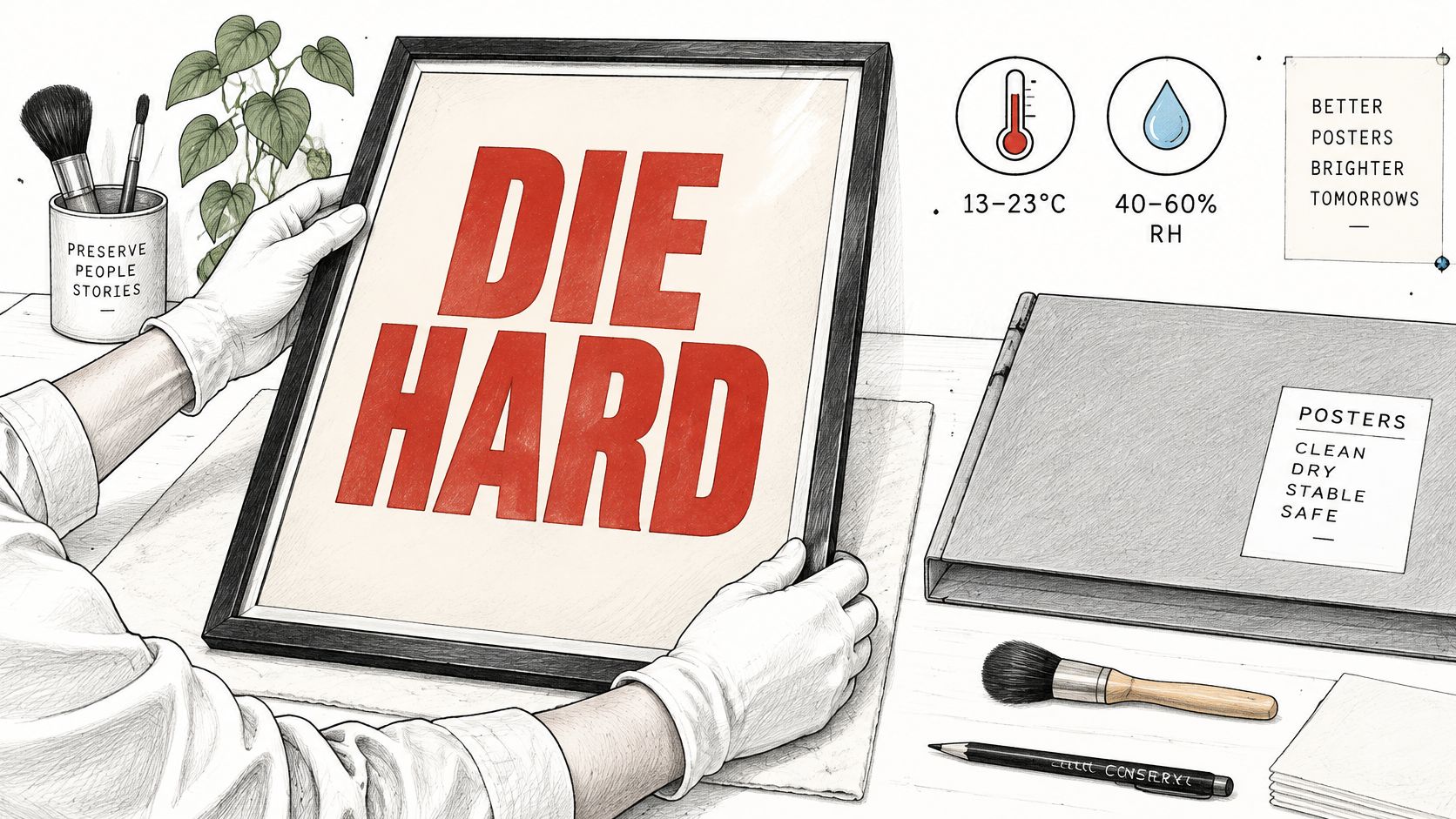
Environmental stability matters more than chasing a single ideal temperature. Scottish archival guidance recommends keeping paper and mixed-material collections between 13°C and 23°C, with relative humidity stable between 35% and 60%; damp conditions can soften paper and promote mould, while excessive dryness increases brittleness and splitting (Scottish Archives collections-care guidance). A large Quad also needs careful handling, since its broad sheet is vulnerable to edge abrasion and stress along folds.
Keep it away from places where conditions swing, including lofts, garages, cellars, radiators and exterior walls. Use neutral-pH paper or a suitable archival enclosure to separate the poster from acidic materials. Buffered paper and board should be lignin- and sulphur-free, with a pH between 6 and 9; calcium-carbonate buffering provides an alkaline reserve to help counter acid deterioration (Archives and Records Association enclosure guidance).
A polyester sleeve, including Mylar or Melinex, can suit a flat, undamaged sheet. Don't use it on torn or powdery paper without advice: its static charge can catch vulnerable material. For a poster that needs rigid support, pair the sleeve with archival board rather than relying on flexible film alone.
Frame for the sheet, not the image
Specify a frame for the full 30 × 40-inch sheet, with enough clearance that the edges and folds aren't compressed. Choose glazing and keep the frame out of direct sunlight. Use reversible mounting, such as corner hinges, rather than tape or adhesive applied to the poster.
If the poster has been rolled, let it acclimatise gradually before framing. Severe folds should be assessed by a conservator rather than forced flat at home. A suitable wall fixing matters too; Miller Waldrop Furniture & Decor's picture hanging guide covers planning a secure, measured installation.
Famous Movie Posters offers frames and framing options, alongside acid-free packaging for posters. If you're comparing mounting approaches, choose one that leaves the sheet removable. The rule is simple: keep the poster flat, dry and unhandled until it's framed.
Choosing Your First Die Hard Poster
For display, choose a clearly dated 1988 UK Quad if its horizontal format suits your wall. Measure the space before buying and decide whether you're happy to see the original folds. They're part of how many British Quads were issued, not an automatic reason to reject a sheet.
For a collection, prioritise provenance and documented dating over a discount. Treat sequel posters and concept artwork as separate collecting areas, each with its own format and scarcity questions. Don't assume that a sequel piece is a cheaper version of the original, or that a rarity label means it's a better buy.
On a tight budget, consider a clearly labelled sequel Quad or another format instead of a bargain advertised as a 1988 original. Ask the seller whether the price is an asking price or a realised result, what the return policy is, and what shipping will cost and how long it's expected to take. Those details need to be confirmed directly; don't assume a particular dealer's policies.
Measure your space, choose a format from the opening table, shortlist two posters and check each against the authentication steps before paying.
Famous Movie Posters sells guaranteed original cinema posters, offers framing options and can use its Request a Poster service to source specific titles that aren't listed. If you're ready to compare formats or ask about finding a particular Die Hard poster, visit Famous Movie Posters.