



You've got the sheet out of the tube and flat on the kitchen table, and the tape measure says 30 by 40 inches. The listing said British Quad, the helmet artwork looks right, the seller had good feedback, and none of it answers the question you care about, which is whether this paper went up in a cinema foyer in 1987 or came off a digital press last year.
Most buying advice stops at the useful but limited stuff: the size, the artwork, the fact that Philip Castle designed the helmet image. Format matters, and you'll get both standard sizes below. But format narrows the field rather than settling it. The checks that separate a genuine 1987 sheet from a convincing reprint are physical and documentary: paper, printing, credits, wear and campaign wording. Those cost nothing but attention, and they're the ones most guides skip.
Table of Contents
- Which Full Metal Jacket Poster Format You Have
- Telling Originals From Reprints Before You Buy
- Price Ranges and What Moves Them
- Where to Buy and What to Ask Sellers
- How to Frame a Poster Without Damaging It
- Storing and Preserving Original Posters
- Confirm Your Poster Before You Buy or Frame
Which Full Metal Jacket Poster Format You Have
Almost every Full Metal Jacket poster in the UK market is one of two things: a US One Sheet or a British Quad. They promote the same film, but they were printed for different countries in different shapes, and they aren't interchangeable for framing, storage or value.
The measurements below are the ones to hold in your head, with the Quad figures matching a dealer listing for the 1987 UK Quad.
| Format | Dimensions | Orientation | Identifying notes |
|---|---|---|---|
| US One Sheet | 27 x 41 in (68.6 x 104.1 cm) | Portrait | Standard US single sheet; the 1987 Warner Bros. release was catalogued at this size |
| UK Quad | 30 x 40 in (76 x 101.6 cm) | Landscape | Classic British cinema format; the 1987 UK campaign used this size |
| Later reissue | Same nominal sizes, 30 x 40 in (76 x 101.6 cm) or 27 x 41 in (68.6 x 104.1 cm) | Landscape or portrait, following the campaign it reprints | Often lacks period printer or distributor credits; check the date printed on the sheet |
| Decorative or fan print | Any size, commonly trimmed to fit a standard frame | Either, copied from the original artwork | Not a theatrical issue; check paper weight and printing method |
Why the Two Campaigns Produced Two Shapes
The film opened in the United States on 26 June 1987 and in the United Kingdom on 11 September 1987 (Wikipedia's Full Metal Jacket record). Warner ran a separate British campaign built around British sheet sizes, which is why a Quad exists alongside the portrait American sheet at all. It grossed £336,532 in its first UK weekend and held the number one position for two consecutive weekends, so the British paper was working in front of paying audiences rather than appearing years later as memorabilia.
The Quad isn't a collector's invention either. The BFI asks for quad format as a priority where available when it requests lead campaign artwork (BFI National Lottery Expanded Screen Fund guidance), which puts the wide sheet alongside the other formats the UK's film archive treats as standard. Keep that in mind when someone offers a portrait sheet as a British release. It usually turns out to be an import or a later print.
Three Checks to Run Today
- Measure both dimensions. Use a metal tape and write down both numbers before you compare anything to a listing.
- Note the orientation. Portrait indicates a US sheet or an import. Horizontal indicates a Quad.
- Compare against the table. A sheet that comes out square, narrow, or obviously trimmed fits neither standard, which is a reason to slow down and inspect the edges rather than a reason to walk away.
Format narrows the campaign, which matters because billing blocks, distributor lines and certification wording all follow the campaign. It doesn't prove authenticity on its own, since reproductions copy dimensions because copying a number is easy. If you want the two shapes side by side before you buy, this comparison of one sheets and quads covers framing as well as size.
Telling Originals From Reprints Before You Buy
A Full Metal Jacket sheet can be the right size and still be a reprint. Rolled or folded describes how it was stored, not whether it came from the original campaign. Check the physical evidence and the printed details together; neither format nor storage state proves authenticity on its own.
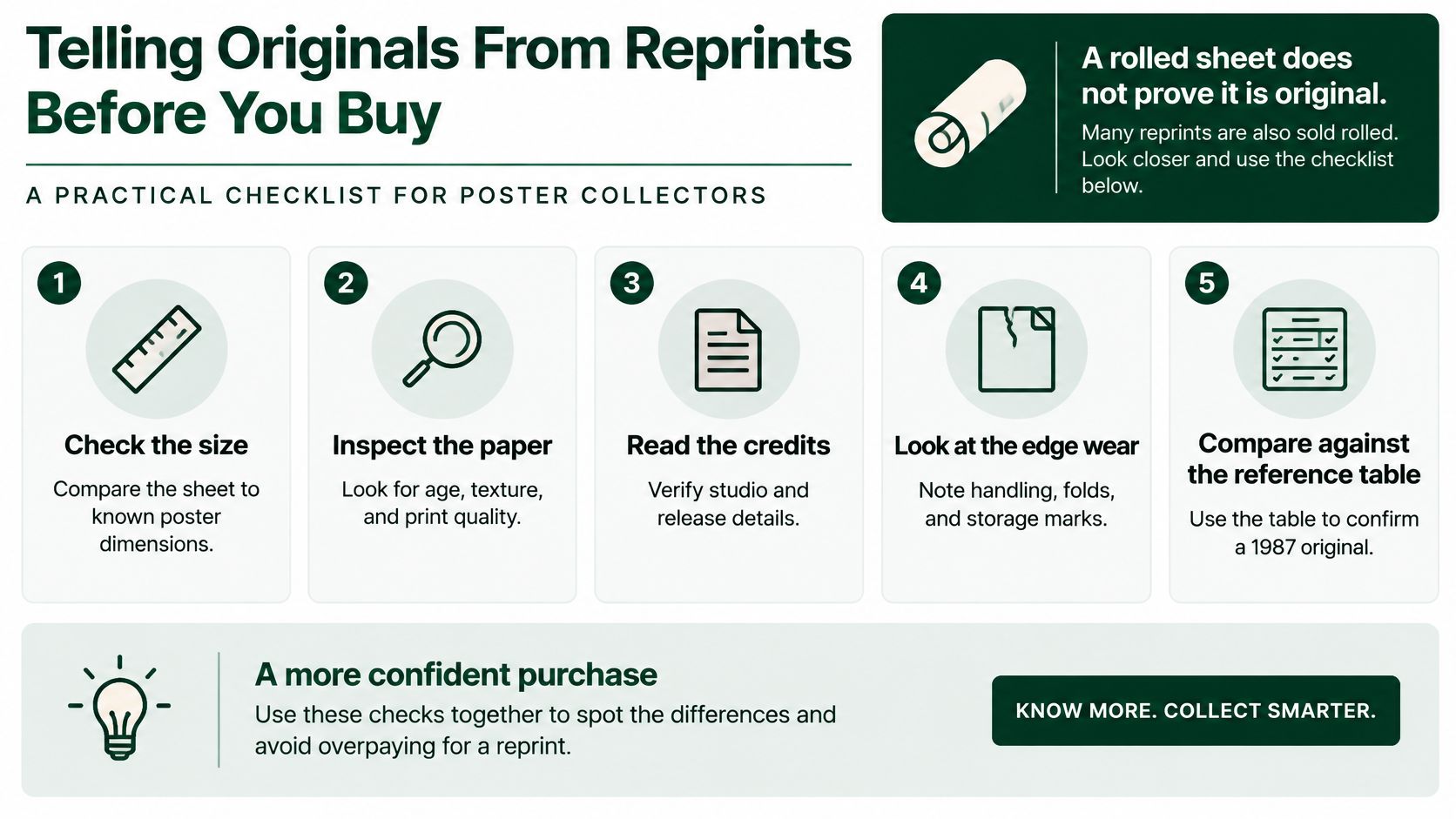
The Checks in the Order a Buyer Should Run Them
- Date and campaign. The UK wide release date was 11 September 1987, according to the AFI Catalog record for Full Metal Jacket. Compare the billing block, distributor credit, release wording and artwork with the campaign the poster claims to represent.
- Paper stock. Look for paper and finish consistent with a period cinema poster. Very thick, high-gloss stock can indicate a later print, but paper feel alone is not proof.
- Folds and wear. Fold lines, pin or staple holes, edge tears and toning can be consistent with cinema display. They are not conclusive: a reproduction can imitate wear, while a genuine sheet may have been kept in unusually clean condition. The BFI film record identifies the film as a 1987 release.
- Printer and certification. Check whether the printer or distributor details and certification wording fit the claimed campaign. Missing information can be a reason to ask for more evidence; credits that point to another campaign deserve closer scrutiny.
- Artwork version. Philip Castle's airbrushed helmet, with the peace badge and “Born to Kill” inscription, is widely copied. Check that the lettering and other printed details belong together and match the campaign claimed by the seller. A mismatch can indicate a composite or later print.
| Check | Typical original | Warning sign |
|---|---|---|
| Release date | Matches the 1987 UK campaign, with UK release on 11 September 1987 | Billing or wording from a later release |
| Paper stock | Paper and finish consistent with a period poster, with possible age toning | Very thick modern stock or a high-gloss finish |
| Folds and wear | Fold lines, pin or staple holes, or edge wear consistent with display | Artificial distressing, or judging authenticity from wear alone |
| Printer and certification | Details consistent with the claimed campaign | Credits that point to another campaign |
| Artwork version | Lettering and imagery consistent with the claimed campaign | Mixed campaign details or blended artwork |
| Rolled state | Neutral; rolling alone proves neither originality nor reproduction | Treating rolled or folded condition as proof |
One mismatch calls for questions, not an automatic verdict. A sheet may be trimmed, faded or missing information that sat at the edge. Several concerns together, such as modern-looking stock, inconsistent credits and artwork from different campaigns, make the case for caution stronger. For a broader guide to buying original movie posters in the UK, check the seller's description and supporting details before committing.
Price Ranges and What Moves Them
A 1987 US One Sheet can provide a starting point for comparison, but its format, condition and sale context matter. Ewbank's Entertainment auction catalogue lists a rolled Full Metal Jacket US One Sheet, measuring 27 by 41 inches, with a guide estimate of £40 to £60. That is the estimate for one auction lot, not a confirmed sale price or a benchmark for other formats. (Ewbank's Entertainment auction catalogue)
For a UK Quad, compare recent sold results for the same format and similar condition. Dealer asking prices show what sellers want, not what buyers have paid.
What Moves the Number
- Condition. Tears, creases, missing corners and stains affect value. Long tears repaired with tape can be particularly off-putting.
- Folds and rolling. Neither state proves originality or guarantees a higher price. Compare the quality of the paper and the condition of any folds, rather than treating rolled sheets as automatically superior.
- Restoration. Linen backing and colour touch-up affect how a poster should be described and valued. The extent of the work matters.
- Campaign version. A UK Quad and a US One Sheet are different formats, even for the same film. Compare like with like.
- Provenance. A receipt, auction record or written dealer description can support a poster's history. It does not replace a close look at the sheet.
- Original versus later print. A later print belongs in a different price comparison from an original theatrical poster, regardless of its condition.
For a useful comparison, match format and condition first. Then account for framing at the poster's measured size, delivery and insurance. A low listing price can become less attractive once those costs are included.
Where to Buy and What to Ask Sellers
Most Full Metal Jacket movie posters change hands through three routes, and each carries a different kind of risk.
- Specialist poster dealers. The best source of properly described stock, with format, size and condition stated up front. The risk is that you're relying on the dealer's description, so ask for it in writing.
- Auction houses. Catalogues usually record format, dimensions and condition, and the sold record becomes provenance. The risk is buyer's premium, plus the fact that estimates are marketing rather than valuation.
- Fairs and private sellers. Occasional finds at good prices and the least accountability. The risk is a repro listed as original by someone who doesn't know the difference.
The Questions to Put in Writing
- Which format is it, and what does it measure exactly? Both dimensions, taken with a tape rather than copied from a listing template.
- Is it an original theatrical issue? The word "original" gets used loosely. Ask for the sentence that says it left a printer in 1987.
- What printer and distributor details appear on the sheet? A seller with the poster in hand can read them off.
- What's the condition, and has anything been restored? Ask specifically about tears, tape, trimming and colour touch-up.
- How has it been stored, and was it ever folded? The answer tells you about creasing and about how it'll be packed.
- What provenance comes with it? A previous invoice, an auction lot number or a named collection all help.
- Do you guarantee it in writing, and what's the returns window? A guarantee you can act on is worth more than a friendly email.
A seller who can't answer the first two questions is telling you something useful. Vague answers about size, format or origin usually mean the poster hasn't been examined closely, and that's your cue to walk.
Delivery deserves its own question. Ask how the sheet will be packed before you pay, because a rolled poster in a soft tube and a folded poster in a padded envelope both arrive damaged. Sellers who handle paper regularly use rigid tubes matched to the format, with the poster rolled print-side out around acid-free tissue so the surface doesn't rub.
How to Frame a Poster Without Damaging It
Framing starts with the tape measure, not the moulding. Frame to the sheet you have, because folded originals, trimmed examples and restored pieces can sit a few millimetres off the nominal size. A frame cut to the listing rather than the paper will either crush an edge or leave a gap.
The sequence below is the one I'd follow for any 1987 sheet.
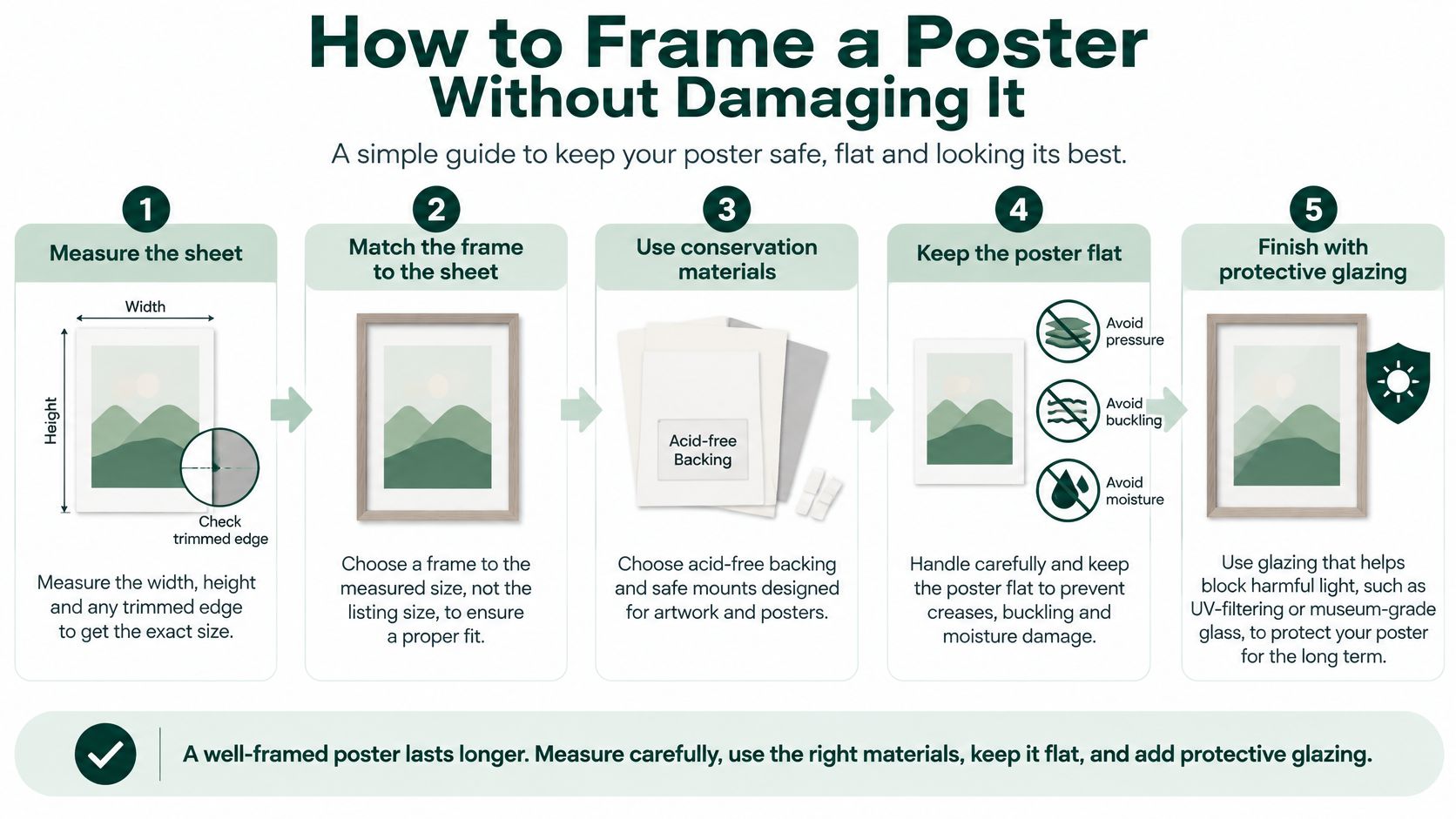
- Measure width, height and any trimmed edge. Check all four corners against a square. A sheet out by more than a couple of millimetres on one side has probably been trimmed.
- Match the frame rebate to the sheet and backing. The rebate is the recess at the back of the frame, and it needs to be deep enough for the poster, the backing board and the glazing without pressure on the paper.
- Use acid-free board and a conservation mount. Standard mount board and cardboard backings off-gas and stain paper over time, and that staining can't be undone.
- Fix with hinges or corner mounts, never tape or glue. Acid-free hinges or photo corners hold the sheet without trapping it. Tape and glue leave brown marks that no conservator can fully remove.
- Keep the paper off the glass. A mount or spacer holds the surface away from the glazing so moisture can't pool against the print and mould can't take hold in the gap.
- Choose UV-filtering glazing on any wall that catches light. Standard glass blocks nothing. UV glazing slows fading rather than stopping it, so treat it as a brake, not a shield.
- Hang away from sunlight, radiators and damp walls. An internal wall beats an external one, and a hallway beats a room that swings between hot and cold.
Rolled originals and restored sheets need a different conversation. A poster that has spent decades in a tube wants time to relax flat before it goes near a frame, and a linen-backed sheet should be handled by someone who has framed one before. If you're weighing a simple frame against a full conservation job, this guide to framing a poster walks through the options.
Storing and Preserving Original Posters
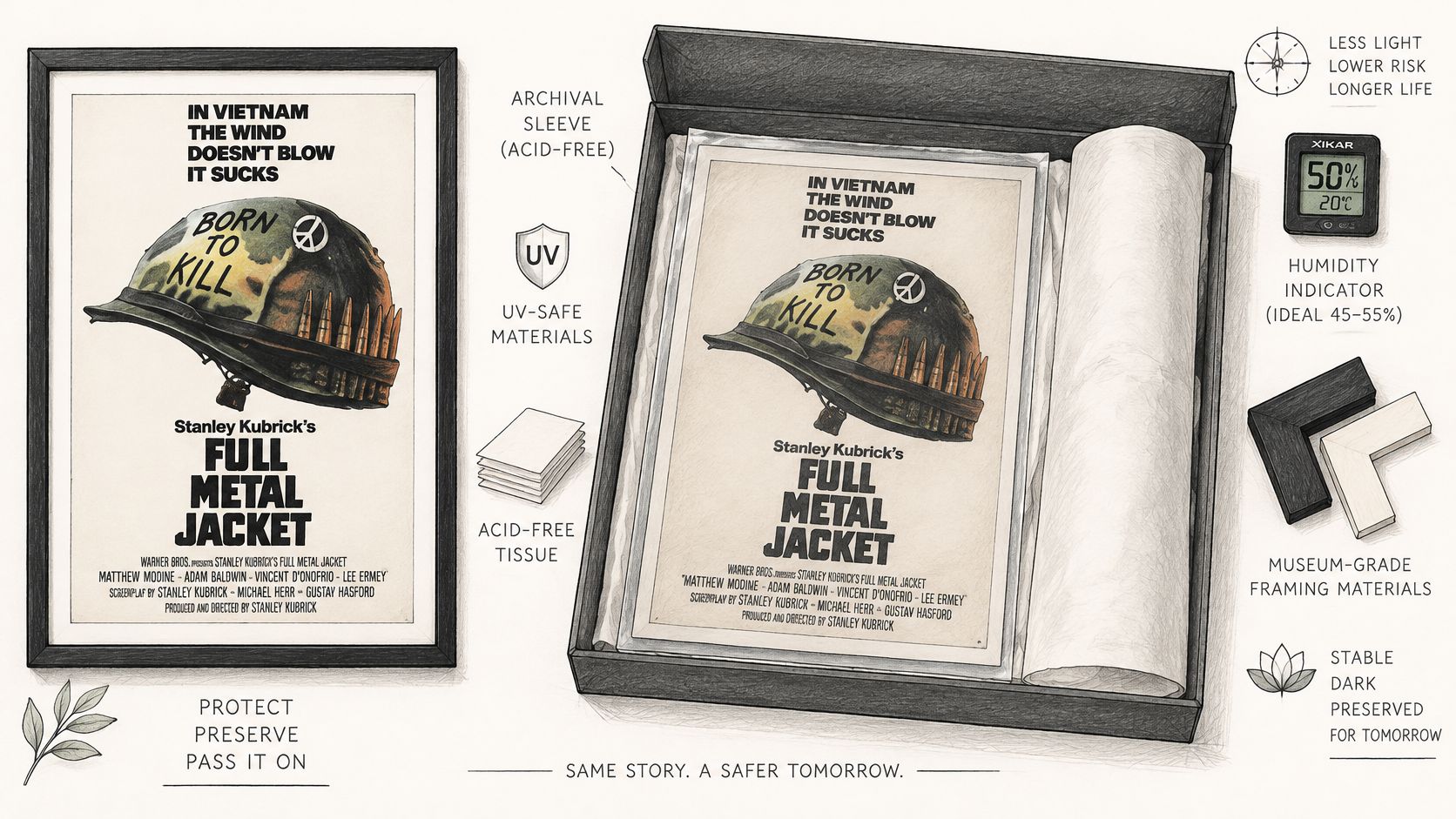
A poster can look sound when it goes into storage and emerge faded, stained or brittle after a season in a hot loft. Choose a cool, dry place with steady conditions, and keep the sheet away from light.
For long-term storage, keep paper flat where practical, protected from light and changes in temperature or humidity. Use materials made for conservation, and avoid conditions that fluctuate sharply.
Materials Worth Buying
- Archival boxes and folders. Choose acid-free materials, with a fit that prevents the sheet from sliding around.
- Chemically stable sleeves. Use plastic or paper pockets free from harmful chemicals. A sleeve should protect the poster without pressing it tightly.
- Conservation board boxes. Sturdy, acid-free board helps shield stored sheets from light and dust.
Places to Avoid
Avoid attics, basements and external walls, where conditions can vary. Keep posters away from damp areas and direct light, and do not leave a sheet exposed on a table during a display change.
Resolving the Humidity Question
There is no single humidity figure that suits every paper poster. Aim for stable, moderate conditions rather than trying to hold the room to a precise number. Large or repeated swings can stress paper, while very dry conditions can leave it brittle. If a poster is valuable or already fragile, seek advice from a conservator.
For broader guidance on caring for antiques in storage, see these antique care tips from Container Self Store.
Check stored boxes periodically for condensation, staining or insect damage. A rolled poster should be allowed to relax flat under board before you handle it.
Confirm Your Poster Before You Buy or Frame
Order matters, and the sequence is short. Confirm the format from the measured size and orientation, run the originality checks against the 1987 campaign, set a budget from the factors that move value, and only then think about a frame and a storage spot. Working in that order stops you paying for a mount on a sheet you'd have returned.
Three figures are worth keeping where you'll see them:
- 27 by 41 inches for a US One Sheet.
- 30 by 40 inches for a UK Quad.
- 11 September 1987 for the UK release, the date any claimed British sheet has to fit.
If you'd rather buy from a dealer than take your chances at auction, Famous Movie Posters is one UK specialist to compare against. The site sells only guaranteed original movie posters and states that it never sells reproductions, which is the dealer's own claim and worth testing with your own checks, exactly as you would with any other seller.
The first action takes five minutes. Measure the sheet in front of you, note the orientation, and check both against the format table before you spend anything else on it.
Famous Movie Posters stocks original cinema posters across US One Sheet, UK Quad and other formats, each one verified before listing and held in archival storage until it ships in packaging built around poster sizes. If you want a 1987 sheet to hang rather than a reproduction to fill a frame, Famous Movie Posters is worth a look. Start with the format table above, then see what's in stock.