



You've found what looks like the perfect Hot Chili Peppers poster for the wall above your turntable. The colours are faded in just the right way, the date looks right, and the price feels almost too fair. Then you scroll. A near identical design appears as a digital download, another as a framed print, and a third seller calls theirs an original. That confusion is where most UK buyers either overpay or walk away from something genuine.
Table of Contents
- Why the Hot Chili Peppers Poster Market Is Tricky
- Understanding Original Posters, Reprints and Fan Art
- Key Eras and Events Worth Collecting
- How to Verify an Original Concert Poster
- Sizes and Formats for UK Buyers
- Storing and Displaying Your Poster
- Where to Buy and What to Avoid
- Final Checklist for UK Collectors
Why the Hot Chili Peppers Poster Market Is Tricky
A typical search starts innocently. You want a poster from a gig you attended, or a gift for someone who still plays Californication on repeat. Within minutes you're looking at lyric prints, recreated setlists, framed album art, and sheets described as vintage without a venue, printer, or year to back the claim up.
That mix is the problem. Etsy UK results for Red Hot Chili Peppers posters show hundreds of relevant listings, including low-priced Californication prints, digital downloads, and setlist-style souvenirs. Some sellers are perfectly clear that you're buying décor. Others use loose language that lets you assume more than they've promised.
Why Looks Mislead Buyers
A convincing vintage finish is easy to produce now. A seller can add grain, soften blacks, distress edges digitally, and print the file on demand. The finished sheet arrives looking aged, but that appearance tells you nothing about when the design was first issued or whether it has any connection to a British date.
Practical rule: Treat apparent age as decoration until a seller gives you dates, dimensions, printing details, and ownership history you can check.
The language on listings makes this harder. Words such as vintage style, retro, concert poster, and original design aren't the same as original printing. An original design might mean the seller created the artwork last month. A concert poster might commemorate a show the seller never attended and the printer never supplied.
There's also a scarcity issue working against you. Genuine concert material tends to stay in collections, which means the most visible online supply is often the newest and cheapest to produce. You'll see plenty of attractive options, but visibility isn't evidence.
Don't let that put you off. It changes how you should shop. Buy the story only when the paperwork supports it, and buy a reproduction happily when it's sold as one and priced accordingly. The mistake isn't choosing décor. The mistake is paying original money for a modern print.
For a Hot Chili Peppers poster, your first job is sorting the market into clear categories. Once you know whether you're looking at an issued tour sheet, official merchandise, a later reprint, or new fan art, the price and the questions you need to ask become much more obvious.
Understanding Original Posters, Reprints and Fan Art
Think of an original poster like a first edition book. The value lies not only in the words or image, but in that specific printing, produced at that specific time, for a specific purpose. A later copy can look identical on a wall and still be a completely different collecting proposition.
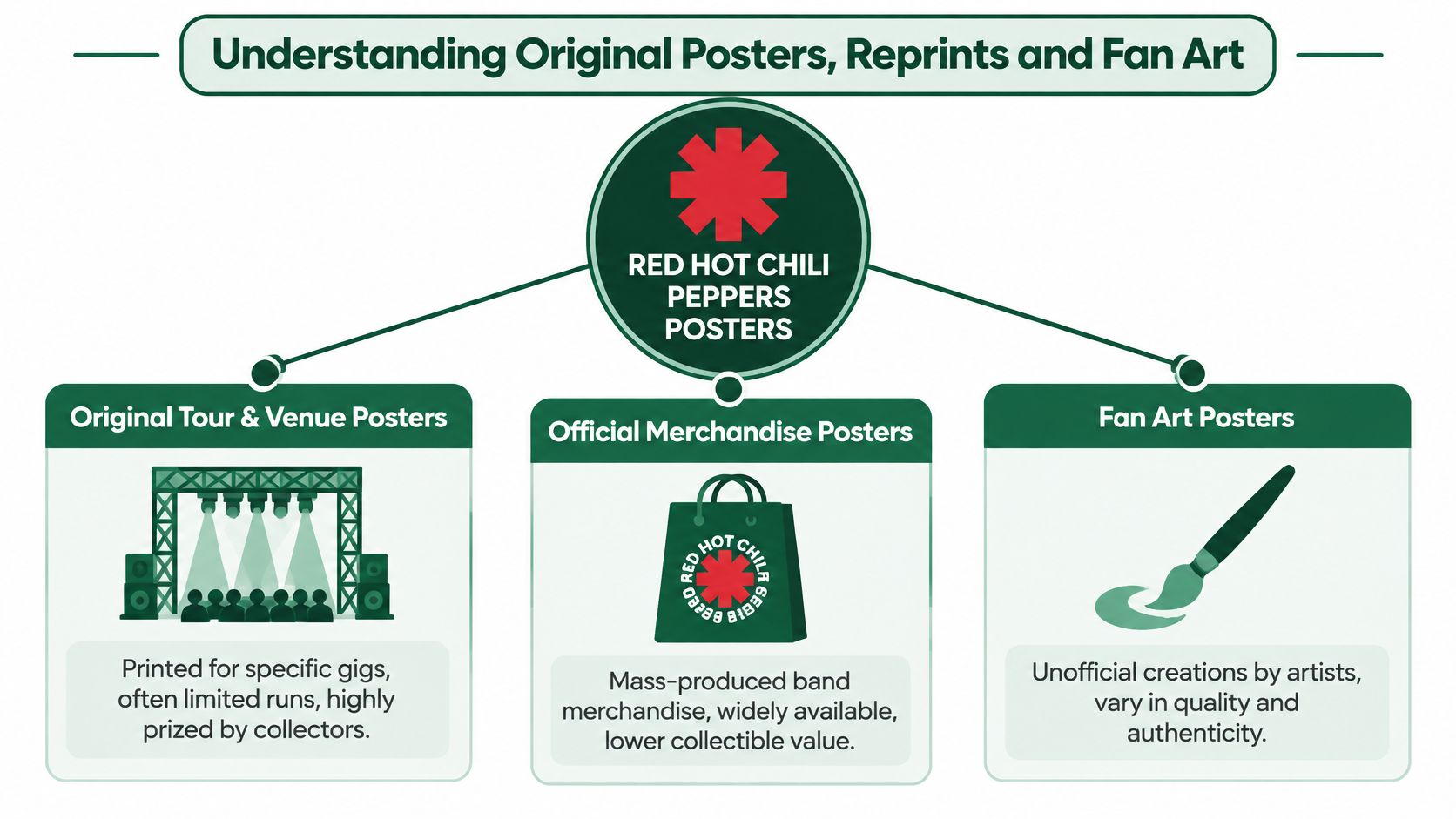
The visual below maps the three categories you'll meet most often when shopping in the UK.
Original Tour and Venue Posters
An original tour or venue poster was printed to advertise or support a particular concert, tour leg, or release at the time. It should have a plausible issuing organisation, a venue or date context where relevant, and physical characteristics consistent with its claimed period. These are the pieces collectors chase because supply was tied to an event, not to endless online reordering.
That doesn't mean every original is rare or valuable. Condition, design, the importance of the show, and surviving numbers all matter. It does mean the sheet itself is part of the event's history rather than a later tribute to it.
Official Merchandise and Later Reprints
Official merchandise posters were made to sell, often in larger runs through shops, venues, or mail order. They can be fully authorised and still carry modest resale value because they were produced for bedrooms, not billposting. Don't dismiss them. For many fans, a clean merchandise poster from the era they love is exactly the right purchase.
A reprint is different again. Someone has reproduced an earlier design after the fact, sometimes with permission and sometimes not. Quality varies hugely, from licensed editions on good stock to thin digital copies. The key question is disclosure. A reprint sold as a reprint is fair. A reprint described with vintage language is where buyers get caught.
Fan art sits outside both categories. It's a new creation inspired by the band, a song, or an album. It may be excellent art. It isn't memorabilia from the tour it references, even if it lists a setlist or copies a period typeface.
Copyright adds another layer UK buyers often miss. GOV.UK guidance on copyright in digital images and photographs explains that a poster's artwork is generally protected automatically as an artistic work, with no registration required, and normally lasts for the creator's lifetime plus 70 years. Buying the paper gives you possession of that copy. It doesn't give you the right to scan it and sell copies.
That distinction matters when a seller offers unlimited downloads of a supposedly old design. Ask who created the artwork and what right they have to reproduce it. A vague answer doesn't prove wrongdoing, but it's a useful signal about how carefully the listing was put together.
Key Eras and Events Worth Collecting
Not every Red Hot Chili Peppers image carries the same weight. A generic band portrait can be reissued endlessly. A poster tied to a documented UK breakthrough, a chart topping album, or a specific London run gives you something firmer to collect around, research, and verify.
This timeline is a useful starting point before you narrow your search to a particular tour or album period.

The Breakthrough and the Arena Years
The UK story gives collectors clear anchors. The Official Charts Company artist history for Red Hot Chili Peppers records five UK No. 1 albums, 10 UK Top 10 albums, and 21 UK Top 40 singles across a career spanning nearly 40 years. Blood Sugar Sex Magik, released in 1991, spent 121 weeks on the UK Albums Chart and reached number 25, marking the early breakthrough period many collectors look for first.
The bigger commercial peak followed with UK chart topping albums including By the Way in 2002, Stadium Arcadium in 2006, and I'm With You in 2011. Posters from this era tend to be easier to research because the tours were larger and better documented. Ease of research is an advantage. You can cross check dates, artwork, and album campaign material with far more confidence.
London gives this period its standout event. Official Charts reporting on Live in Hyde Park reaching number one notes the album reached number one in August 2004 and stayed there for two weeks, documenting three London concerts that reportedly set records as the highest grossing concerts at a single venue at the time. A Hyde Park poster therefore isn't just band imagery. At its best, it's tied to a defined run of shows and a measurable UK milestone.
That same reporting shows why these songs still drive demand, with Can't Stop at 131 million UK streams in 2022, Californication at 109 million, Snow (Hey Oh) at 78 million, and Scar Tissue at 61 million. If you're comparing a song themed print with a concrete tour sheet, that context helps. For background on the catalogue behind those titles, the House of Lyrics artist directory is a handy reference when you're matching lyrics or song titles to a design before you buy.
The Reunion Period
Unlimited Love in 2022 added another UK number one and brought guitarist John Frusciante back into the collecting conversation. Modern material is easier to source and authenticate through purchase records, but it hasn't had decades to become scarce. Buy it because you were there or love the design, not because a seller promises future rarity.
How to Verify an Original Concert Poster
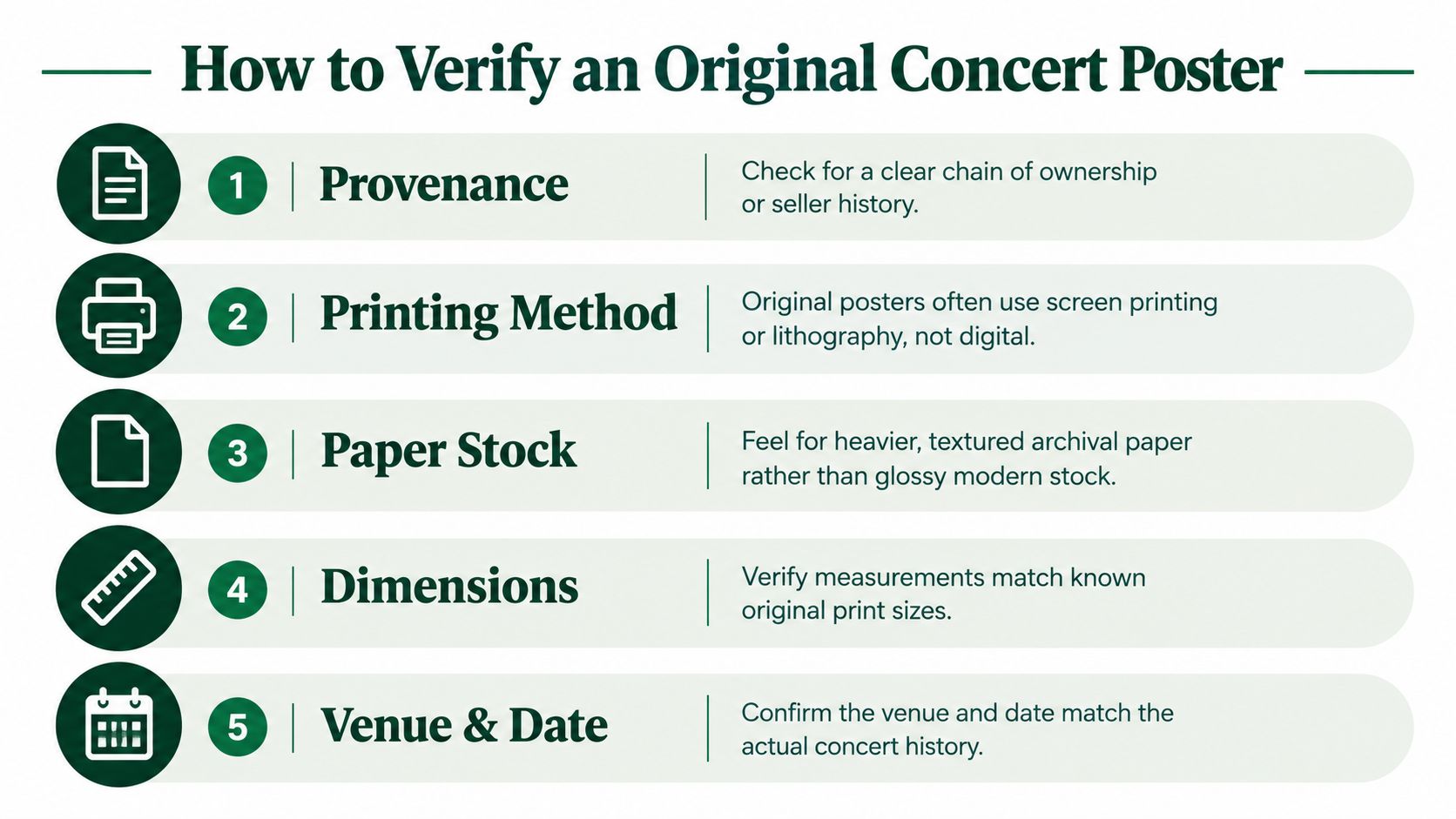
Verification isn't one clever test. It's a bundle of small checks that either line up or don't. Start with the visual guide, then work through the questions below before money changes hands.
Build the Evidence File
Ask the seller to state, in writing, the essentials. You're looking for consistency, not a polished sales story.
- Claimed year and event: Does the venue and date match a real UK appearance, or is the design generic band artwork with a date added later?
- Issuing organisation: Can the seller name the printer, promoter, record company, or merchandise source connected with the sheet?
- Printing method and paper: Does the description explain how it was printed and what the stock feels like, rather than relying on photographs alone?
- Dimensions: Has the actual sheet been measured, including any borders, trimming, or folds that affect the usable image?
- Chain of ownership: Is there a receipt, prior dealer record, or credible account of where the poster has been kept?
None of those points proves authenticity on its own. Together, they make a claim testable. GOV.UK copyright guidance on automatic protection for artistic works is also a reminder to record any artist or photographer credit, because copyright protects the expression of the work and duration varies by the type of work and when it was created. Credits help you date and classify a piece more accurately.
Condition needs its own separate record. Ask about folds, pinholes, tears, paper loss, tape, staining, fading, and restoration individually, not with a single cheerful grade. Sellers who've handled the poster carefully can usually answer plainly. Sellers working from stock images often can't.
The short video below is worth watching before you inspect photographs from a seller, particularly for how you should think about handling and close examination.
If you're new to originals in the broader poster market, this guide to original movie posters in the UK covers the same provenance first mindset in a neighbouring collecting field. The principle transfers directly. Documentation beats atmosphere, and a seller who welcomes questions is usually safer than one who pressures you to decide from a thumbnail.
A genuine poster can survive detailed questions. A weak listing usually falls apart when you ask for measurements, reverse side photographs, and a written condition report.
Sizes and Formats for UK Buyers
Size causes expensive mistakes because buyers order frames from a listing title. Don't. Measure the sheet yourself when it arrives, edge to edge, and check whether borders or printer marks are included. A poster that's been trimmed or mounted won't behave like a standard frame insert.
The most useful UK benchmark is the UK Quad. A UK Quad listing showing the standard British sheet size reflects the common 30 by 40 inches, or approximately 76 by 102 centimetres, format. Music posters don't always follow cinema conventions, but the Quad gives you a shared language with framers and dealers who handle both.
| Format | Dimensions (inches) | Dimensions (cm) | Orientation |
|---|---|---|---|
| UK Quad benchmark | 30 by 40 | Approximately 76 by 102 | Usually landscape |
| Original tour or venue sheet | Varies by issue | Varies by issue | Varies |
| Merchandise or décor print | Varies by seller | Varies by seller | Varies |
That variation is exactly why UK poster sizes at Striped Circle is worth checking before you assume a frame labelled large will fit. Use it to sense check terminology, then rely on your own tape measure for the final decision. Listing photographs can crop borders without making that clear.
If you're comparing British and American formats, this explanation of the difference between a One Sheet and a Quad will stop you mixing up sheet names when a seller handles film and music material side by side. The names sound interchangeable to new buyers. They aren't.
Weight and Wall Space
A framed 30 by 40 inch poster is a substantial object once glazing and backing are added. Check your fixings and wall type before it comes back from the framer. It's a dull point, but it's the one that prevents a good purchase ending up on the floor.
Storing and Displaying Your Poster
Good storage is mostly about stopping small, avoidable damage. Paper remembers folds, damp, light, and rough handling. Your aim is to keep the sheet flat, dry, supported, and away from materials that transfer acid over time.
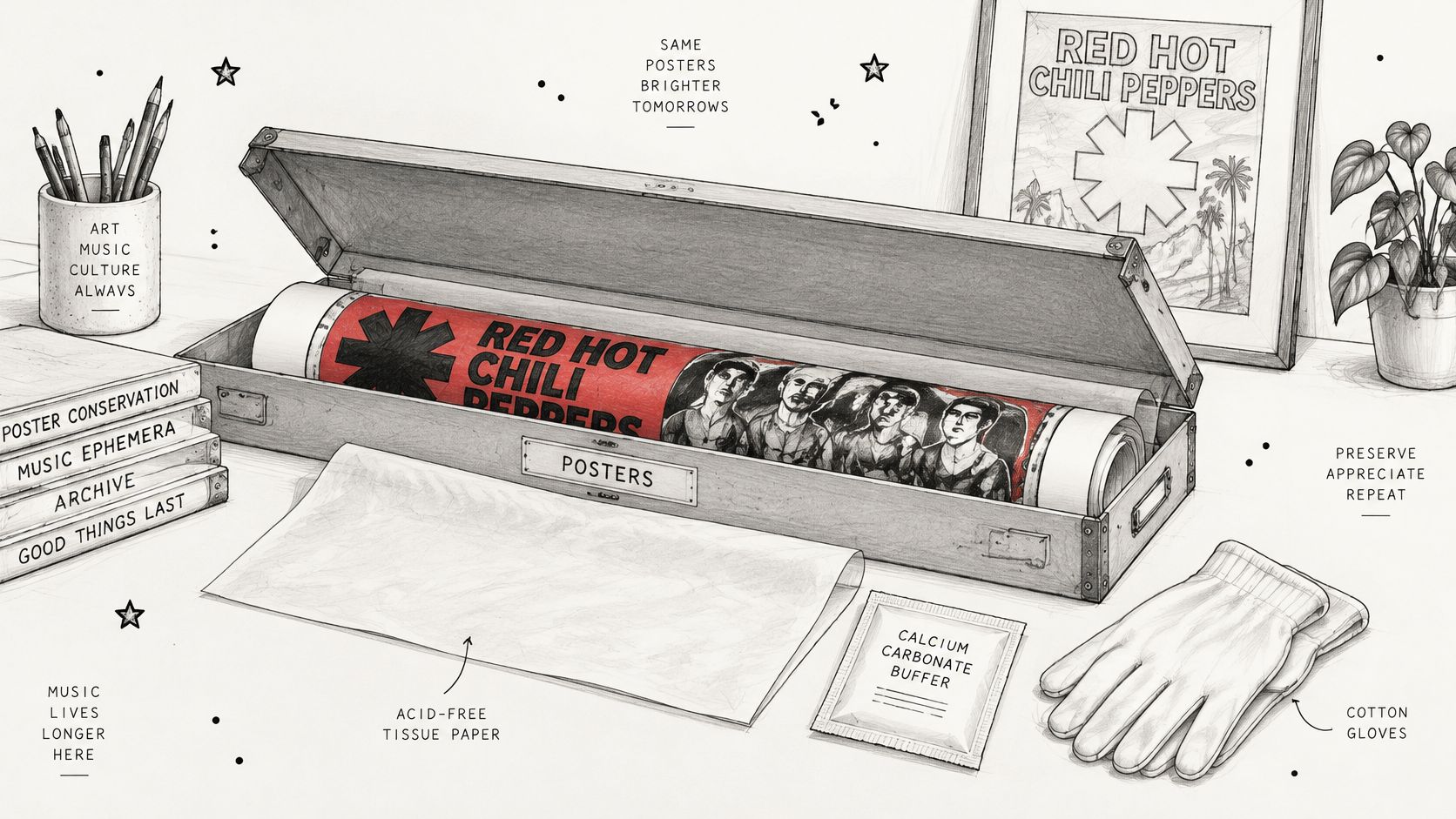
The illustration below shows the kind of simple conservation set up that suits a growing collection at home.
Flat Storage That Actually Works
Store valuable posters flat in archival boxes rather than leaving them rolled for years. A buffered box helps maintain a more stable environment for the paper, and individual acid free polyester pockets reduce handling damage when you want to look through the collection. Handle sheets with clean, dry hands and support them with both hands so corners don't bend.
- Keep it flat where possible: Rolling is fine for transport, but long term flat storage reduces curl and edge stress.
- Separate each sheet: Pockets or suitable interleaving stop surfaces rubbing when you move the box.
- Choose a dry room: Avoid lofts and garages where temperature and moisture swing through the year.
- Log what you own: Keep measurements, condition notes, and provenance paperwork with a copy stored digitally.
For a fuller walkthrough of flat storage at home, this FAQ on how to store movie posters applies the same paper care principles collectors use for music sheets. The materials advice is consistent because the risks to printed paper are consistent.
When you display a Hot Chili Peppers poster, keep it out of direct sunlight and away from radiators or steamy rooms. Ask your framer for reversible mounting so nobody tapes or glues the sheet to a backing board. Tape feels harmless in the moment. Removing it later is where tears and staining begin.
Shipping deserves the same care if you sell or lend a piece. Use a sturdy tube sized for the sheet, protective tissue, and enough room so the poster isn't forced into a tight roll. Most transit damage I've seen comes from rushed packing, not from the courier.
Where to Buy and What to Avoid
Where you buy changes the risk more than most buyers realise. A specialist dealer should be able to explain what a poster is, what it isn't, and how they reached that view. A marketplace seller might offer a bargain, but you're often doing the authentication work yourself.
That's a fair trade off if you enjoy research and the price reflects the uncertainty. It isn't fair when a listing borrows the language of originals while supplying a modern decorative print. Read the full description, not just the title, and save screenshots of any authenticity claim before you pay.
Questions That Reveal a Serious Seller
Ask who issued the poster, how it was printed, what the exact sheet size is, and whether the photographs show the actual item. Then ask about returns if the poster doesn't match the description. Straight answers build confidence. Evasion is information too.
- Guarantee in writing: Will the seller state clearly whether the item is an original printing, a reprint, or fan art?
- Actual item photographs: Can you see the reverse, corners, edges, and any defects rather than a clean digital mock up?
- Provenance paperwork: Is there a receipt, prior ownership note, or artist and photographer credit recorded?
- Sensible pricing: Does the price make sense for the category being claimed, or does it depend on you not asking questions?
Dealer test: If a seller can't tell you whether you're buying an issued poster or a reproduction, price it as a reproduction or walk away.
Auctions need extra discipline. Set your maximum before bidding, factor in fees and framing, and don't let a famous venue name do the verifying for you. A recreated setlist can mention a real concert and still have no connection to material produced for that night.
Provenance led collecting sounds slower. In practice, it saves money. You'll pass on some attractive sheets, but the ones you keep will have a file that supports the story when you insure, frame, resell, or explain the piece to another fan.
Final Checklist for UK Collectors
Use this sequence every time, whether you're buying a modest merchandise sheet or chasing a poster from a landmark London show. It keeps emotion in the purchase without letting it run the authentication.
- Name the category first: Decide whether the seller is offering an original printing, official merchandise, a later reprint, or new fan art.
- Anchor it in UK history: Connect the design to a real album era, venue, or date you can research independently.
- Demand the evidence file: Record the claimed year, issuer, printing method, paper, dimensions, credits, and chain of ownership.
- Grade condition separately: Note folds, pinholes, tears, staining, fading, tape, paper loss, and any restoration in plain language.
- Measure before framing: Check the full sheet yourself and plan for the weight of the finished frame.
- Store the paperwork: Keep receipts and seller claims with the poster so the next owner inherits evidence, not folklore.
Remember the legal line as well. Physically owning a poster doesn't transfer the right to reproduce its artwork, photography, or typography. If you plan to scan, reprint, or use a design commercially, stop and check the rights position first. National Archives guidance on UK copyright terms and related rights shows why dating and identifying each element matters, because terms differ by material type.
Buy décor for décor reasons and originals for documented reasons. When you keep those decisions separate, a Hot Chili Peppers poster becomes much easier to enjoy. You know what you've paid for, why it belongs in your collection, and what story you can attach to it.
If provenance led collecting is how you want to buy, Famous Movie Posters applies that same originals only discipline to guaranteed original film posters, with careful storage, protective packaging, and free UK shipping. Browse the catalogue when you're ready to see how verified posters should be described, handled, and sent to collectors.