



You have a sheet, or a listing photo, with David Bowie in front of a maze and a gold title underneath. It looks like the Labyrinth film poster you remember from 1986, and you want to know whether the paper is a cinema original or a later wall print before you pay, frame it, or store it. That question is practical, not nostalgic. The same faces and the same maze were printed for more than one country, and a pretty image does not tell you the format.
What follows is how I read a British sheet of this film: what the original cinema object is, why the named size and the measured paper often disagree, how the collage is built, how National Screen Service paper was issued, and what keeps a survivor flat.
Table of Contents
- What the Original Labyrinth Poster Is
- UK Quad Size, Catalogue Measurements and Frames
- How the 1986 Artwork Is Arranged
- Signs of an Original Cinema Issue
- Archival Storage for the Paper Itself
- Confirm the Sheet Before You Buy
What the Original Labyrinth Poster Is
The picture viewers usually mean is David Bowie as Jareth set in front of a maze, Jennifer Connelly as Sarah among the other figures, and the film title in gold for Jim Henson's 1986 fantasy. That image is a cinema advertisement for one film. It is not a modern decorative print of a hedge maze, and it is not a roundup of other maze movies.
A UK reader usually wants three things at once. You want to read the artwork properly. You want the paper matched to a release format. And you want to avoid a reprint described as if it had hung in a foyer.
The campaign belongs to the original British release. Cinemas were supplied with wide British quads, and other countries received their own sheets that reuse related imagery. Bowie, a maze and the title can sit on more than one size. Country, year, paper size and orientation have to agree before a frame opening or a price makes any sense.
Practical rule: If a seller can name the picture but not the format, you do not yet know what you are buying.
The next step is the size record, including two museum measurements that will not match a catalogue name. After that comes the collage itself, then the way British cinema paper was issued, then how to keep a survivor without forcing it into a frame the day it arrives.
UK Quad Size, Catalogue Measurements and Frames
A nominal British quad is 30 by 40 inches, about 76.2 by 101.6 centimetres, and is displayed in a horizontal orientation. For the 1986 Labyrinth campaign, that name gives you a useful starting point, not a guaranteed cut size. A sheet's measured edges and a catalogue's format label can differ, so check the paper before ordering a frame.
The American US one sheet is about 27 by 40 inches and portrait. Related Bowie artwork does not make the formats interchangeable: a one-sheet frame will not take a quad. The difference between a one sheet and a UK quad comes down to dimensions and orientation as well as the campaign.
Two museum sizes that are not the name
The Victoria and Albert Museum's David Bowie Archive record gives one UK-held poster's dimensions as 99.65 by 68.65 cm, about 39.2 by 27.0 inches. That is not the nominal 30-by-40-inch quad size. A separate framed theatrical poster is recorded at 109.4 by 73.8 by 3.8 cm, a measurement that includes the mount and frame, not just the paper.
| Format | Dimensions | Orientation | Release details | What it tells you |
|---|---|---|---|---|
| UK Quad | 30 x 40 in (76.2 x 101.6 cm) nominal | Landscape | 1986 UK campaign | The familiar British format name does not confirm the sheet's exact measurements |
| US One Sheet | About 27 x 40 in | Portrait | US theatrical advertising | Related artwork, different dimensions and orientation |
| V&A archive poster | 99.65 x 68.65 cm (about 39.2 x 27.0 in) | Recorded paper size | 1986 sheet in the David Bowie Archive | A museum record may give measurements that differ from the nominal quad size |
| Framed V&A example | 109.4 x 73.8 x 3.8 cm | Includes mount and frame | Framed theatrical poster | Outside frame dimensions are not paper dimensions |
Measure the sheet itself, including its margins. Do not cut it down to fit a nominal quad opening: that can remove printed edges and evidence of folds or handling. The frame should fit the paper you have, not the dimensions implied by its catalogue label.
For archival framing, use a reversible mount and suitable glazing. Adhesive tape can stain the paper, and removing it may worsen tears. Japanese repair paper, wheat-starch paste and acid-free board are materials used in conservation; a mount that supports the edges without hiding them is preferable when margins are short.
Measure the sheet first. The frame should house its actual dimensions, not correct the catalogue description.
How the 1986 Artwork Is Arranged
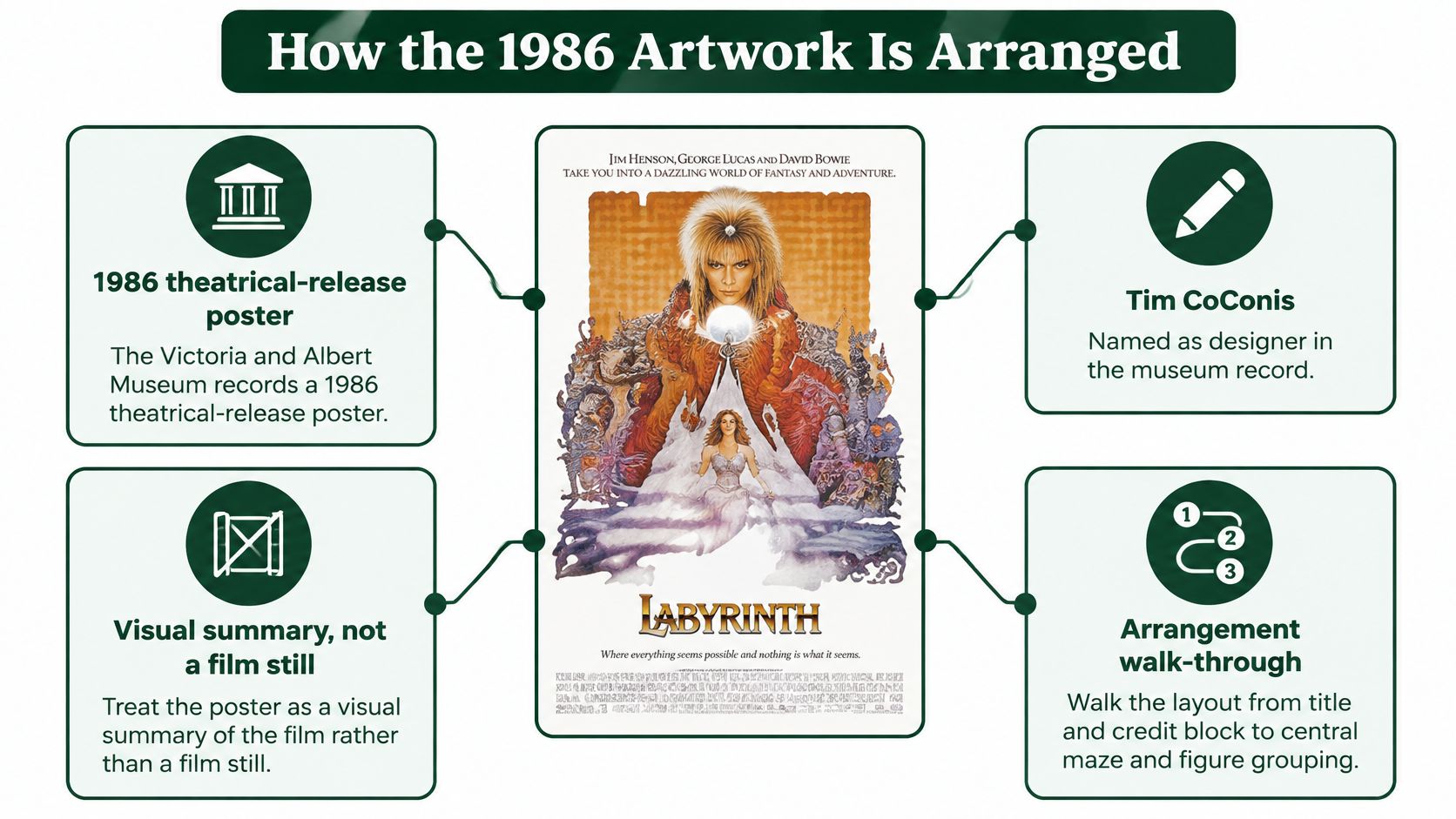
A 1986 British cinema poster has to work at foyer distance: the title catches the eye, while the figures and fantasy setting give the film its character. The Victoria and Albert Museum record identifies this theatrical-release poster and credits its design to Tim CoConis.
From the Goblin King down through the collage
Jareth draws the eye first. Bowie stands before the maze, bringing the Goblin King and the film's central puzzle into one view. Below, Sarah, a castle and supporting characters fill out the composition. Large gold lettering gives the title its own clear place in the design.
The artwork combines character portraits with fantasy imagery rather than relying on a single scene. The hedge maze suggests Sarah's journey, while Jareth's crystal ball and the puppet creatures reinforce the film's strange, storybook world. That layered arrangement makes the sheet read as a compact campaign image, not a portrait of its stars.
As a 1986 British cinema object, the poster's visual identity is only part of its interest. The V&A catalogue measurements and the nominal UK quad size differ, for practical reasons such as the sheet's recorded edges and catalogue method. Those figures describe particular records and examples, not a universal measurement for every surviving poster.
For context on British campaign paper from the decade, see this guide to posters from the 80s. Artwork can help identify the design; the paper's format, printing and campaign details are separate clues to whether a sheet is an original cinema issue.
Signs of an Original Cinema Issue
A UK original was made for theatrical display during the release campaign, not printed later as home decoration. In Britain the National Screen Service commonly issued cinema posters under a licensing arrangement. As the Folkestone collectors' guide sets out, the material remained NSS property and was meant to be returned after the cinema exhibition ended. That limited, non-retail life is one reason surviving examples are scarce and collectible.
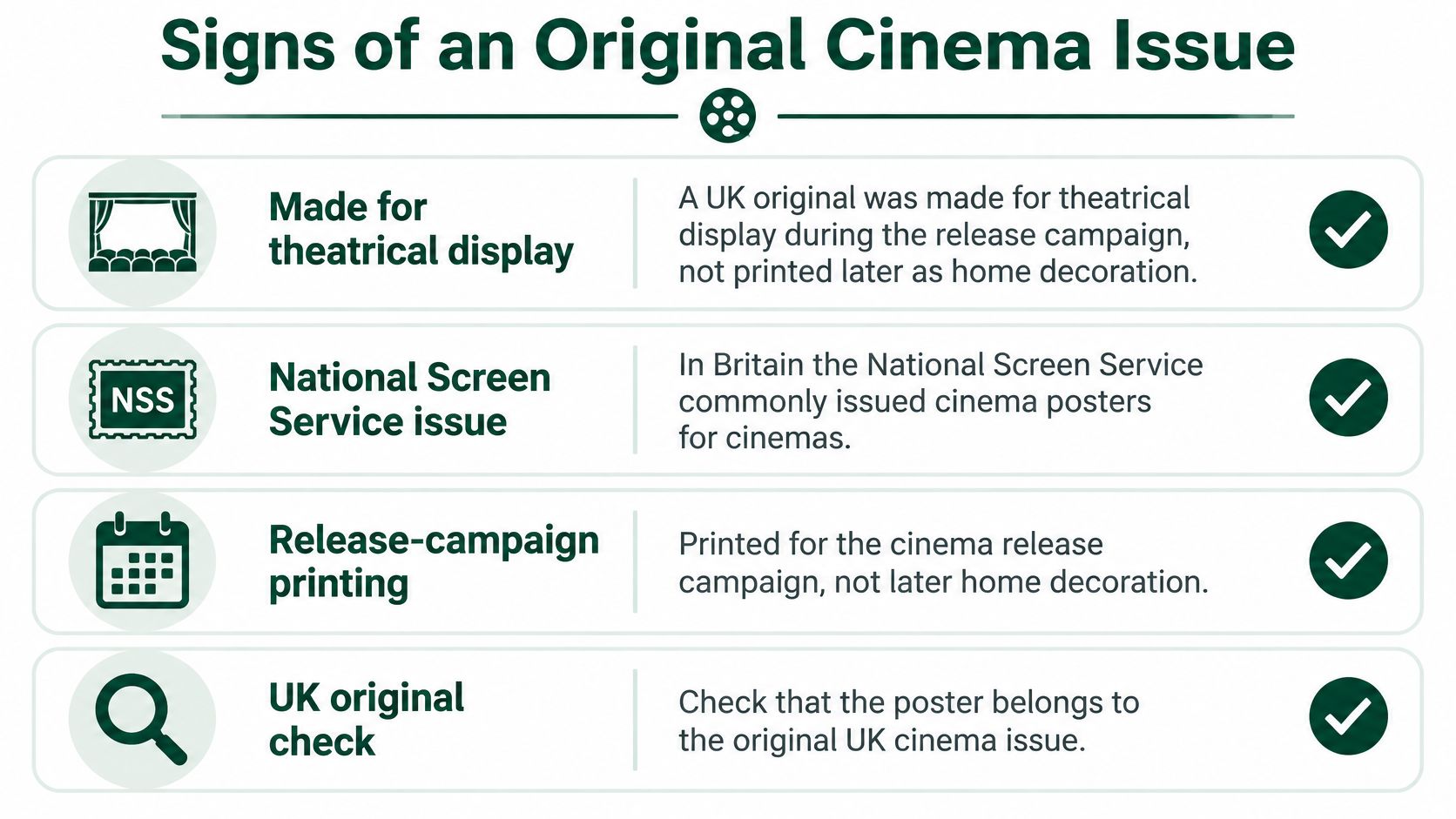
An original should be judged by release-era format, printing, campaign details and condition. Looking old is not a test. Phrases such as "vintage style" or "rare image" do not say whether a sheet is an original, a re-release, a reproduction or a later decorative print.
Five checks on a listing
- Confirm the date and the origin. You want a stated 1986 date and a stated UK or US origin, not a guess from the costumes.
- Measure the paper, not the frame or the mount. Outside glass and a mount board will always read larger than the sheet.
- Distinguish horizontal from vertical formats instead of assuming one image. A quad and a one sheet can share the campaign art and still be different objects. Identical or closely related imagery on another national format is a cataloguing error waiting to happen.
- Read the printing where a UK quad is claimed. Look for single-sided 1986 cinema printing and the campaign tagline, not a modern gloss on both sides.
- Read the paper's history in its handling. Folded paper can be theatrical handling rather than automatic damage. A thick glossy modern sheet is a different object, however faithful the picture.
If the listing cannot name format, year and origin, it has not identified an original.
Condition still matters, but only after those fields. A bright reprint with no folds is not "better" than a returned cinema sheet with honest creases. It is a different thing, made for a different purpose.
This short look at the film is useful once you already know which paper you are assessing, because the story and the poster are not the same object.
Archival Storage for the Paper Itself
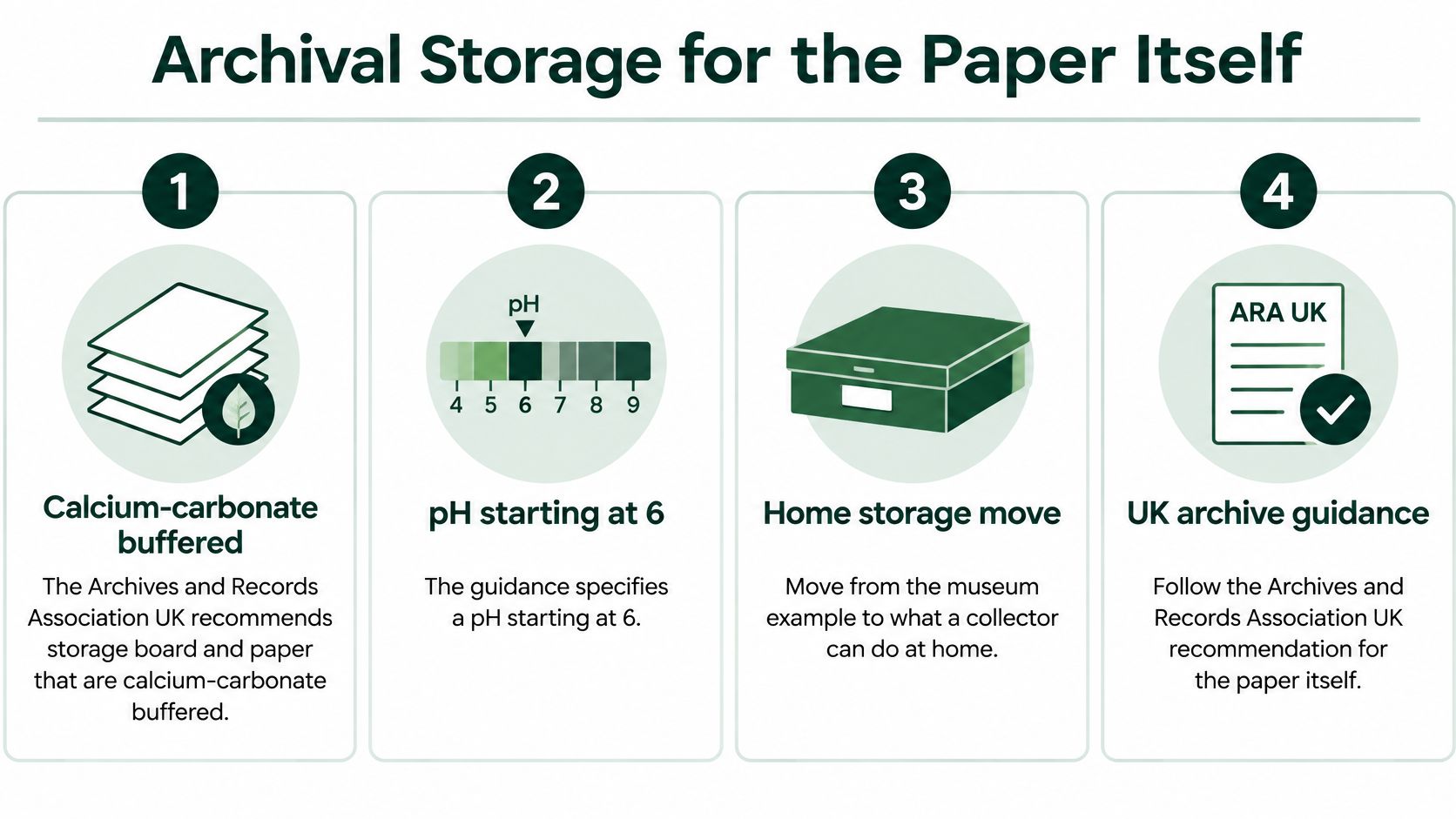
Once you know you have cinema paper, the job moves from the museum case to a cupboard. The Archives and Records Association UK recommends storage board and paper that are calcium-carbonate buffered, have a pH between 6 and 9, and are free from lignin and sulphur. The buffer is an alkaline reserve against acid as the sheet ages. A box labelled "acid-free" is not automatically the right enclosure. Composition and buffering matter as well.
The National Archives advises a clean, controlled environment, and acid-free envelopes where a polyester sleeve is unsuitable. Keep the poster away from damaging materials, and away from uncontrolled damp or heat. Ordinary cardboard and acidic packing paper are the usual mistakes, because they are what the poster arrived in.
Buffer, inks and the things that must stay off the sheet
The Canadian Conservation Institute identifies a 3% calcium-carbonate alkaline buffer, in cotton-rag or chemically purified wood-pulp enclosures, as suitable for most paper. That is a limit, not a universal rule. Dyes, pigments or inks that dislike higher alkalinity may need an unbuffered product. A gold-printed fantasy poster should not be dropped into the first archival sleeve on offer. Look at the inks and the condition first.
Keep these off the sheet:
- Acidic mats and ordinary cardboard. They feed acid back into the paper you just paid to protect.
- Staples, paperclips and rubber bands. They dent, rust or perish against the surface.
- Adhesive tape. It stains, and removal makes tears worse.
- Damp and heat. An uncontrolled room undoes a good folder.
Acid-free tissue, a stable sleeve and archival board reduce handling, but only after the inks and condition are considered. Our own poster storage FAQ walks through flat storage versus a tube if you are deciding where a large sheet fits.
If a poster arrives rolled, weight it flat for as long as it needs rather than forcing it into a frame the same day. If it is folded from cinema use, do not iron the folds out. They are part of the object. Enclosure and a stable room come first. Frame only after the paper has been measured.
Confirm the Sheet Before You Buy
Pay only when the listing has already done the identification. I would walk away from a handsome photo that cannot answer four plain questions.
- Ask for a named cinema format. That means an original 1986 issue, either UK quad or US one sheet, plus country and year. "Labyrinth poster" is not a format.
- Reject substitute language. "Vintage style" and "rare image" are not those fields. They describe a mood.
- Check the bare paper. Note single-sided printing, the tagline "Where anything is possible" on a claimed UK quad, and whether folds look like cinema handling rather than later damage.
- Choose the frame last. Use a reversible mount sized to the sheet you measured, not a nominal 30-by-40 opening bought because the title sounded British.
When you want a guaranteed original instead of a reproduction, we sell only guaranteed original movie posters at Famous Movie Posters, and we do not sell reprints. A title that is not listed can be requested through our sourcing service. Framing stays a separate step once the sheet is in hand. Protective packaging matters because a badly travelled poster is what becomes the next tape repair.
The decision is binary. If format, year, origin and paper size are not stated, wait.
Famous Movie Posters sources, authenticates and sells original cinema posters, including British quads and US one sheets from campaigns such as the 1986 release of Labyrinth, and we do not offer reprints. If you want a sheet identified by format, year and origin rather than by a decorative copy of the maze, browse the catalogue or ask us to source a title. Visit Famous Movie Posters and tell us which original you are looking for.