



You've finally taken that treasured original British Quad or US One Sheet out of its acid-free sleeve. It's flat on the table, the colours look richer than they did in storage, and the thought is obvious: a backlit frame could make the artwork feel like a cinema display again. The harder question is whether the same light that gives the poster its theatrical presence will also shorten its life.
That's the decision behind movie poster frames with lights. A light box isn't just a more dramatic picture frame. It changes the poster's exposure to light, affects how the paper is mounted and handled, introduces electrical and ventilation considerations, and can complicate future conservation work. For a reproduction, those compromises may be acceptable. For an original, especially a scarce Quad or One Sheet, they deserve careful thought before the first poster goes into the frame.
Table of Contents
- Why Backlighting an Original Poster Is a Bigger Decision Than It Looks
- Types of Lighted Frames a UK Buyer Will Actually Find
- Matching British Quad, One Sheet and Other Original Sizes to the Right Aperture
- Power, Mounting and Installation Considerations for the Home
- Protecting the Poster Without Killing the Look
- Common Myths About LED Poster Frames and What Conservation Actually Says
- Troubleshooting, Care and Long-Term Maintenance
Why Backlighting an Original Poster Is a Bigger Decision Than It Looks
A collector usually starts with the visual result. The artwork glows evenly, dark areas gain depth, and the display has the unmistakable feel of a foyer or underground cinema. London's public advertising history helps explain why this presentation feels so familiar. Illuminated advertising hoardings appeared at Piccadilly Circus in 1908, only two years after the tube station opened, while electric billboards were added to the London Pavilion façade in 1923. By the 2000s, those displays had moved from neon to LED, and by 2011 LED displays had replaced the neon lamps, as recorded by Campaign's history of Piccadilly Circus lighting.
The appeal is therefore more than decoration. A backlit poster borrows the visual language of British public display, but a cinema poster is still a vulnerable paper object. The collector has to balance the immediate drama of illumination against cumulative exposure, ultraviolet radiation, heat, mounting pressure and handling.
The original poster changes the calculation
A modern reprint can usually be replaced if a poor frame causes damage. An original cannot be treated so casually. Paper may show fading gradually, with a small change in a dark ink area becoming obvious only after the poster has spent years in a bright room. Once colour has shifted or an edge has become brittle, switching off the frame won't restore the artwork.
British conservation guidance is clear that all light can harm images and text. The National Preservation Office guidance for exhibiting archive and library materials identifies wavelength, intensity and duration as contributing factors and recommends eliminating UV below 400nm. The British Library and Collections Trust guidance also supports keeping light-sensitive material around 50 lux, never exceeding 100 lux for extended periods, excluding UV and using time switches or out-of-hours covers, as outlined in this photographic collections conservation guidance.
Practical rule: If the poster matters more than the lighting effect, design the display around the poster's preservation needs, not around maximum brightness.
That doesn't mean an original must remain hidden. It means the frame should be selected as part of a conservation strategy. Measure the light at the poster surface, use suitable glazing and backing, avoid continuous operation, and keep the display away from windows and heat sources. If those conditions can't be achieved, a high-quality reproduction is the more sensible candidate for illumination.
Types of Lighted Frames a UK Buyer Will Actually Find
The UK market offers several routes into illuminated display, and they don't all suit original paper. The first step is to separate front-loading convenience from archival suitability. A frame that makes poster changes quick may use a pressure-sensitive snap system, while a collector-focused installation may prioritise reversible mounting and stable glazing instead.
| Frame Type | Typical UK Price | Best For | Main Trade-off |
|---|---|---|---|
| Snap-front LED clip frame | Budget to mid-range | Reproductions, retail-style swaps and standard poster formats | Easy access, but the front-loading mechanism may put pressure on original paper |
| Edge-lit acrylic panel | Mid-range | Slim domestic installations and evenly lit modern prints | Very neat profile, though bespoke sizing can increase cost |
| Magnetic front-loading light box | Mid-range to premium | Frequent poster changes and clean presentation | Convenient access, but magnets and tight loading need careful handling |
| DIY LED strip conversion | Low material cost to variable | Makers, test displays and non-valuable prints | Cheapest route can produce hotspots, heat, cable and safety problems |
Snap-front LED clip frames use hinged profiles that release the glazing and poster from the front. They're practical in a hallway, home cinema or shop environment, particularly where the image will change regularly. Their weakness is that repeated opening and sliding can catch corners, drag paper against the aperture or compress an uneven mount.
Edge-lit acrylic panels place LEDs around the edge of a light-guiding sheet. The panel is usually slim and gives a controlled, modern appearance. A 30 mm profile edge-lit product is advertised for A4 through A0 formats, with a visible A1 size of 820 × 574mm, according to Jansen Display's Posterlight LED A3 product information. The same listing illustrates an important buying point: the frame's visible area is not automatically the same as the paper's full size.
Magnetic front-loaders can be excellent for temporary displays, provided the poster is supported across its full width and never forced into a tight aperture. DIY LED strip conversions are more variable. An indoor UK LED frame lists 12W at A4 and 24W at A3 in its product specifications, showing how power draw rises with display area, while a home-built strip system may have no reliable diffuser, thermal path or tested power supply.
For a broader explanation of light-box choices, the UK guide to light boxes for movie posters is a useful starting point, but product claims still need checking against the particular poster you intend to display.
Matching British Quad, One Sheet and Other Original Sizes to the Right Aperture
A frame can be beautifully made and still be wrong for the poster. British collectors commonly work with a British Quad measuring 30 × 40 inches, a US One Sheet measuring roughly 27 × 41 inches, and a UK One Sheet measuring 27 × 40 inches. Those proportions don't line up neatly with A-series apertures, even when the advertised frame appears close.
A Quad is wider and shorter than a US One Sheet. Put either into an unsuitable A-series frame and the window may crop printed borders, leave an unwanted gap around the image or expose a strip of unlit paper. Light can leak around the artwork, creating a bright halo that draws attention away from the design. A mat may also cover distributor information, credits or edge artwork that forms part of the original.
Measure the paper, not the listing title
Use this sequence before ordering:
- Measure the poster itself. Record width and height at several points, because older paper can be slightly out of square.
- Check the frame's internal aperture. Don't rely on the nominal A0, A1 or A2 label.
- Confirm the visible window. The visible area may be smaller than the internal space because of the frame lip, masking or mat.
- Allow a small tolerance. A practical fitting tolerance is 2 to 3mm, provided the poster is supported without forcing it, as specified in the sizing requirements for this comparison.
- Check the light path. Look for gaps where illumination could spill beyond the artwork.
- Decide how the poster will be held. Original paper should not be glued, dry-mounted or trapped under excessive pressure.
| Poster Format | Poster Size (inches) | Recommended Aperture | Watch Out For |
|---|---|---|---|
| British Quad | 30 × 40 | Bespoke Quad aperture matching the measured visible area | A-series frames can crop borders or create side gaps |
| US One Sheet | Roughly 27 × 41 | Bespoke One Sheet aperture matched to the poster | Quad proportions can cut into the top or bottom |
| UK One Sheet | 27 × 40 | UK One Sheet aperture with measured window | Check whether the frame masks credits or border artwork |
| A0 reproduction | A-series format | Exact A0 visible window | Nominal sizing may not match the printed trim |
| A1 reproduction | A-series format | Exact A1 visible window | Confirm the advertised visible dimensions |
| A2 reproduction | A-series format | Exact A2 visible window | Smaller frames can show uneven edge lighting |
The guide to Quad poster frames helps explain why a British Quad needs a frame designed around its proportions rather than a generic poster product. For a valuable original, send the supplier the actual measurements and ask for the aperture drawing before purchase. That extra check is cheaper than discovering that the frame has permanently hidden a border or allowed the poster to slide against an illuminated edge.
Power, Mounting and Installation Considerations for the Home
Choose the wall before choosing the frame. A backlit poster should be kept away from direct sunlight, radiators and damp areas, and it shouldn't be hung directly against an exterior wall where condensation can develop inside the glazing. The National Archives guidance for framed prints and drawings also advises avoiding south-facing light where possible, using UV-protected glass and keeping framed material clear of conditions that encourage mould.
A domestic installation usually needs a nearby 13-amp socket or fused spur within reach of the frame's 12V DC cable. Check that the supplied adapter is low-voltage and marked as compliant with BS-EN 61558. Don't hide an unknown transformer inside a sealed cavity or pack the cable tightly behind the frame, because both access and heat management matter.
Work from the wall outwards
Weigh the frame fully assembled, including glazing, poster, backing and power components. Then choose fixings for the actual substrate:
- Plasterboard: Use suitable cavity anchors, or fix into a stud where possible.
- Brick: Use rawlplugs with No. 8 or No. 10 screws suited to the wall and bracket.
- Solid wood: Use wood screws directly, while checking the material thickness and screw length.
Route the cable through shallow trunking or a drilled channel to the nearest socket. Leave a small service loop behind the frame so the driver can be inspected and the frame can be removed without pulling the cable at its entry grommet.
Leave 25mm clearance above the frame for ventilation and below it for cable exit. Confirm the total installed weight against the bracket's rated load, not just the empty frame specification. A large Quad frame may become substantially heavier once glazing and a rigid backing board are included.
The UK Building Regulations lighting guidance places display lighting within a wider energy-efficiency framework. Its guidance refers to an average light-source efficacy of 80 lumens per watt, or a space power limit of 0.3W/m2, with 65 lumens per watt for high-excitation-purity light sources. Those requirements don't replace safe installation practice, but they're a reminder that illuminated display products aren't exempt from responsible lighting design.
Protecting the Poster Without Killing the Look
The most useful preservation principle is simple: light exposure is cumulative. A light source can feel cool to the hand and still deliver a damaging combination of wavelength, intensity and duration. LED technology reduces some heat and UV concerns compared with older sources, but “LED” alone doesn't describe the spectrum, output or control method.
For original paper, UK conservation guidance commonly uses 50 lux as a working target for light-sensitive material and advises never exceeding 100 lux for extended periods. Measure lux at the poster surface, not at the LED panel, because the glazing, diffuser and distance change what reaches the paper. The conservation guidance also warns that the source shouldn't sit inside or underneath the display case, where heat and fire risk can increase.
Build the display around controlled exposure
A sensible setup uses warm or neutral illumination, a diffuser and a timer. 3000K to 4000K LED colour temperatures generally give vintage artwork a warmer, less clinical appearance, but colour temperature isn't a safety certificate. Ask for confirmed UV performance and inspect the actual specification rather than assuming that a fashionable colour setting protects the print.
Keep the LED assembly separated from the poster by an air gap or diffuser. A practical separation of 50mm to 100mm can help manage heat and reduce visible hotspots, but the result still needs checking at the paper surface. Use a timer or smart plug to limit daily illumination to four to six hours rather than leaving the frame running continuously. That doesn't make an unsuitable frame safe, but it reduces exposure.
| Factor | Safe Target | Risk Threshold |
|---|---|---|
| Light at poster surface | Around 50 lux for light-sensitive originals | Above 100 lux for extended periods |
| UV | Eliminated, including wavelengths below 400nm | Any undisclosed or measurable UV output |
| Operating time | Controlled daily use with a timer | Continuous illumination |
| LED distance | Air gap or diffuser, typically 50mm to 100mm | LEDs directly against the poster |
| Glazing | UV-filtering, conservation-appropriate material | Ordinary glazing with unknown UV transmission |
| Mounting | Reversible, acid-free and non-adhesive methods | Dry-mounting, adhesive contact or tight pressure |
Cold-white LEDs can still cause problems if they're bright and left on for long periods. Economy strip lighting is especially difficult to assess when its UV output, spectrum and thermal behaviour aren't documented. A high-CRI panel may render colour attractively, but CRI-90+ is not, by itself, proof of zero UV. Treat colour rendering, UV performance and lux as separate checks.
For broader guidance on backing, glazing and reversible methods, consult this poster framing guide. The British Library's conservation benchmark is clear: valuable objects should be mounted with reversible adhesives and acid-free archival-quality mount boards, using methods that don't damage the object or accelerate degradation, as explained in its preventive conservation guidance.
Common Myths About LED Poster Frames and What Conservation Actually Says
The phrase “LED safe” is often treated as a complete answer. It isn't. LED describes the light-producing technology, not the intensity, spectrum, UV output, heat path or operating schedule. One UK light-box seller states that its products have been independently tested by a leading laboratory and certified to British and European safety standards, and says its LEDs generate no heat and no UV that could damage the poster, as set out in its light-box FAQ. Those are useful product claims to verify, but collectors should still measure the finished installation.
The assumptions that cause trouble
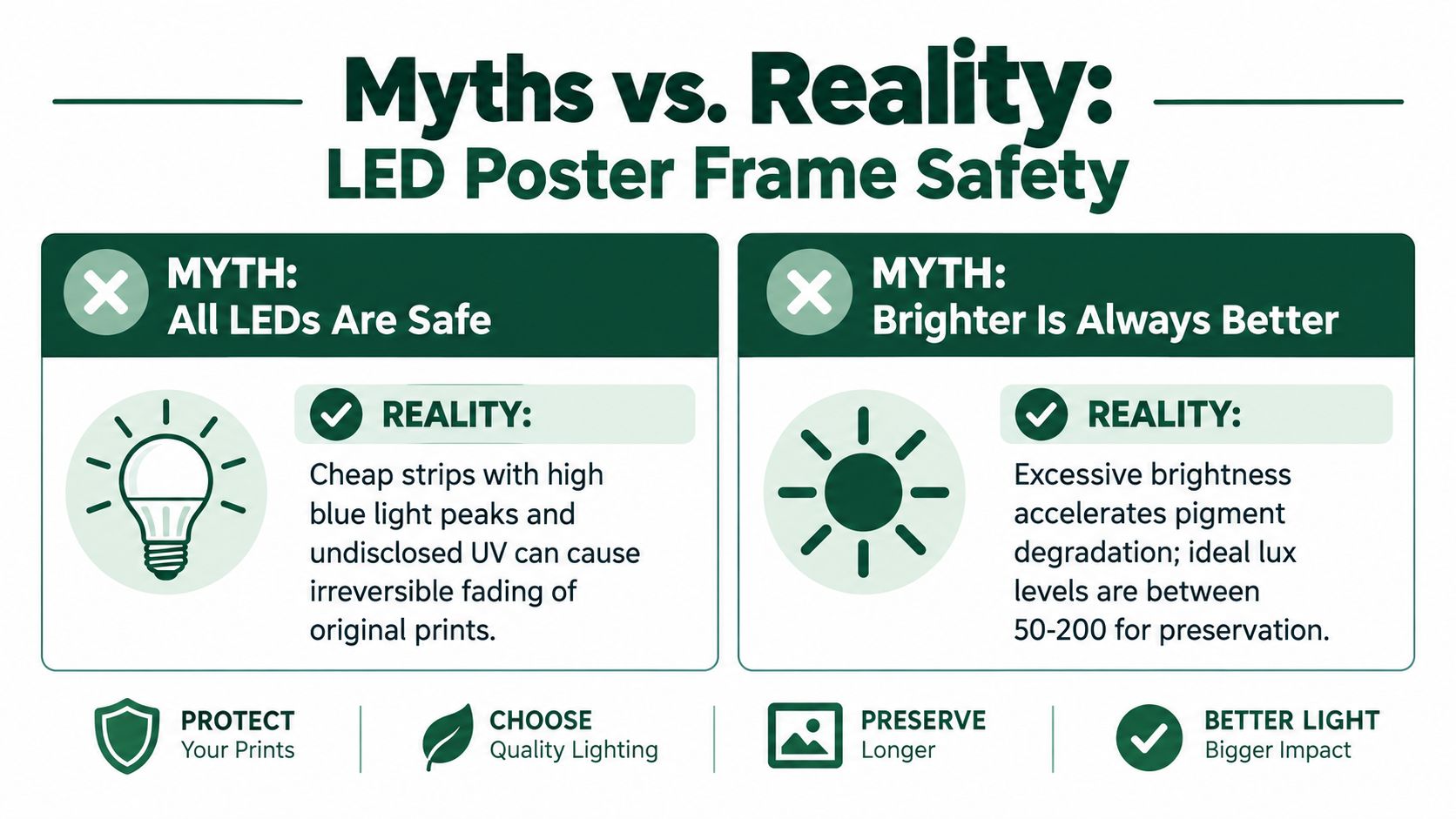
Myth, all LEDs are safe. Cheap strips may have pronounced blue output, poor diffusion and undisclosed UV performance. A low-temperature surface doesn't prove that the poster is receiving harmless light.
Myth, brighter always looks better. Excess brightness can flatten perceived contrast and increase fading risk. For originals, the working conservation target remains around 50 lux, with extended exposure above 100 lux treated as a risk, according to the Collections Trust guidance cited earlier.
Myth, an original can never be displayed lit. It can be displayed responsibly when the collector controls lux, excludes UV, manages heat and uses a duty cycle. A reproduction is still the easier choice for a permanently illuminated installation.
Myth, a daylight bulb is automatically suitable. “Daylight” describes appearance, not conservation performance. High blue output, heat and unknown UV can all be problematic.
Myth, glass protects by default. Standard picture glass isn't automatically UV-filtering. The National Archives recommends UV-protected glass, and its advice also supports acid-free hinges with a water-soluble adhesive for framed paper material.
A safe-looking LED frame can still be an unsuitable environment for an original poster.
The defensible setup is modest rather than dazzling: verified low-UV lighting, a measured output at the paper, a diffuser or air gap, UV-filtering glazing, reversible mounting and timed operation. If the supplier can't provide meaningful information about the light source or driver, use the frame for a reproduction instead of gambling with an irreplaceable original.
Troubleshooting, Care and Long-Term Maintenance
Front-loading frames are convenient, but the convenience can encourage rushed handling. Release the latch fully, support the poster across its width and never pull a corner free while the rest of the sheet is still trapped. Keep hands, tools and the frame lip clear of the printed surface, especially when swapping a folded or previously rolled original.
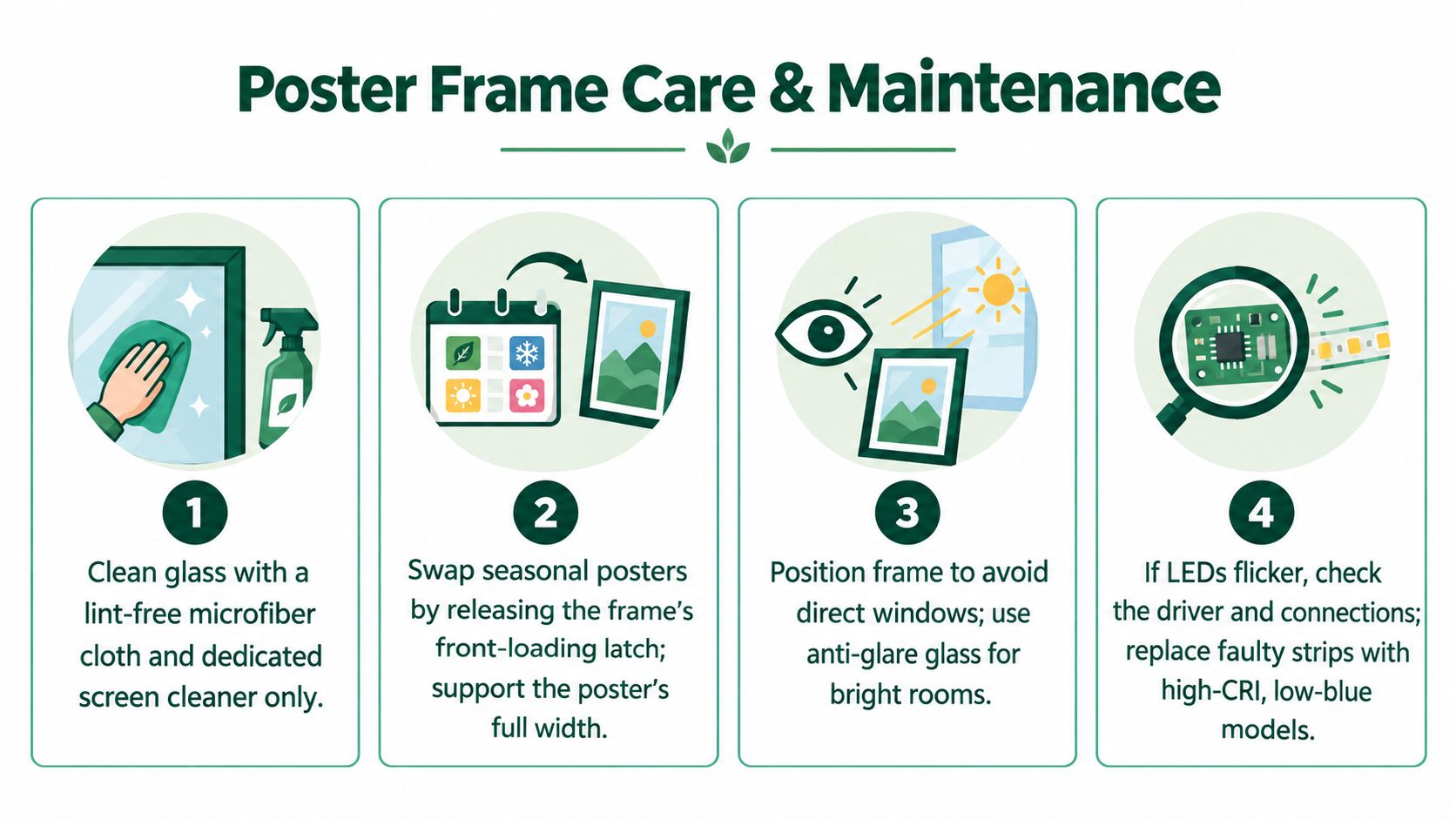
Seasonal changes are safer when you treat the poster as a full sheet rather than a loose insert. If daylight creates glare, change the frame's angle or room position before increasing brightness, and consider anti-glare glazing where it doesn't compromise the presentation. Never clean across an exposed poster with liquid, even if the mark appears superficial.
A routine that catches faults early
At a six-month check, inspect the driver temperature, the cable at the entry grommet, the condition of the seals, condensation inside the glazing and any reduction in light output. A yearly deep clean should use a lint-free cloth and a small amount of isopropyl alcohol around the frame and glazing, never on the artwork and never where liquid can run into the mount.
Use the symptom to guide the response:
- Dim output: Suspect the driver or a failing power connection before replacing the poster.
- One dark LED strip: Inspect for a broken solder joint or local strip failure.
- Yellowing haze: Treat it as a possible seal failure and remove the artwork for inspection.
- Poster discolouration: Switch off the illumination and move the poster to a conservation mount immediately.
Flickering may be a loose connection or a failing driver, but mains-side faults aren't a collector's repair project. For practical guidance on when to call an electrician for flickering, use an electrical professional's checklist and isolate the frame if the fault persists. Retire the frame rather than risk the poster when heat, condensation, damaged glazing or unstable power can't be corrected confidently.
If you're choosing an original Quad or One Sheet, Famous Movie Posters offers verified original cinema posters, framing options and guidance on matching formats to display solutions. Visit Famous Movie Posters to find an authentic poster, check the available framing support and plan an illuminated installation that respects both the artwork and its long-term condition.