

The most repeated advice about Polish film posters is that you'll know one when you see it. The imagery is so odd, so unlike anything a studio marketing department would have signed off, that the style itself gets treated as a guarantee of authenticity. That reasoning collapses the moment there's a price on the listing.
Design is the easiest part of a poster to copy. Every reprint, every unofficial reissue and every modern tribute gets the design right, because the design is the point of them. What they rarely reproduce faithfully is the physical record underneath it: the paper of a particular decade, the single horizontal fold, the sheet dimensions, the printer's mark, the signature with a date next to it.
This is a guide to Polish film posters as an authentication problem first and an art appreciation second. The art deserves the attention it gets. The checks that protect your money are the dull ones, and they're the ones sellers tend to leave out.
Table of Contents
- Why Polish Film Posters Look Nothing Like Hollywood Ads
- How the Polish School Reached Global Audiences
- Designers and Artistic Styles to Recognise
- Formats That Mark a Polish Original
- Notable Polish Posters and What They Teach Buyers
- Reprints, Reissues and Modern Tributes
- How to Check a Polish Poster Before You Buy
Why Polish Film Posters Look Nothing Like Hollywood Ads
Take a poster for a film built around Sidney Poitier at the height of his fame, then look at the Polish version. There's a fair chance the star isn't on it at all. No face, no billing block, sometimes nothing that names the plot, just a symbol that makes sense once you've sat through the film.
That wasn't a quirk of taste. Post-war Poland had no commercial art market under Soviet control, and the nationalised film industry removed the usual pressure to feature stars or reproduce a studio's advertising campaign. Artists worked under censorship, but they gained increasing freedom to build personal, symbolic readings of each film, as the BFI's archive entry on a Polish poster for To Sir, with Love explains.
Set that against a typical Western one-sheet, where faces, billing block and tagline do the selling, and the photography is a studio decision before a designer touches it. The Dietrich and Valente lighting contrast is a useful reminder of how controlled that look was, and how much of a Western poster's pull comes from lighting and likeness rather than interpretation.
A Western one-sheet sells the ticket. A Polish poster argues with the film.
The pool of source material widened from the mid-1950s, when films from Europe, America, Japan and elsewhere reached Polish screens, so designers were no longer working only from domestic cinema. The BFI archive holds a Polish poster for To Sir, with Love, a 1967 film, designed by Maria Ihnatowicz in 1969.
So when a sheet turns up in a listing, ask which job the image is doing. Interpretation is a good sign about the tradition, but it isn't evidence about the print, because a reproduction can carry just as clever an image as the original.
How the Polish School Reached Global Audiences
A poster's date can tell you which chapter of the Polish tradition it belongs to, but it cannot prove that a sheet is original. Start with the history, then check the object itself.
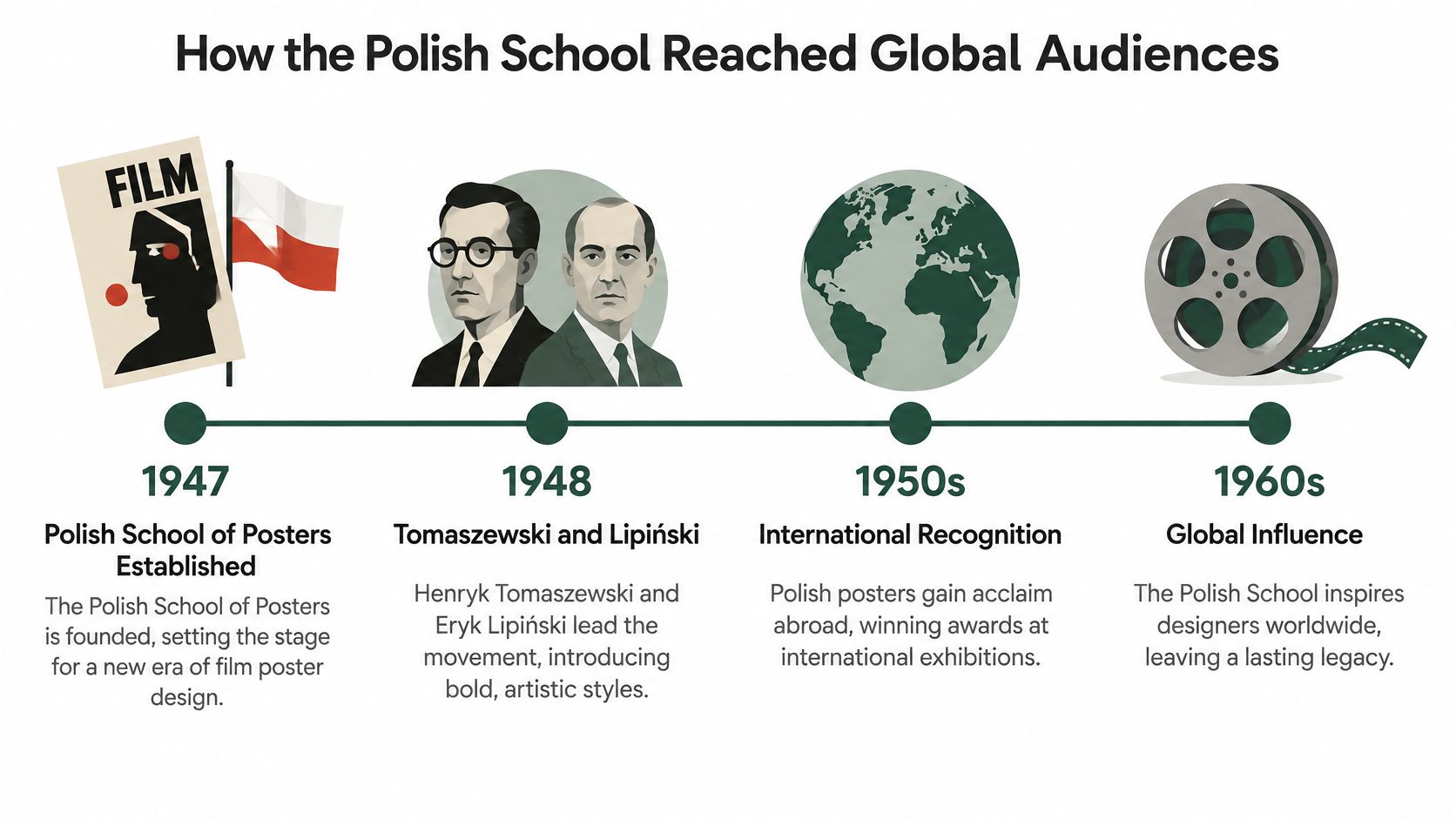
The Polish School of Posters was established in 1947. The following year, Henryk Tomaszewski and Eryk Lipiński took part in the International Poster Exhibition in Vienna. The show displayed 2,000 posters from 18 countries, and the two artists won 12 gold medals, according to the BFI's history of the Polish poster. Their success put Polish poster design before an international audience early in the movement's development.
Cinema posters then took a distinct direction. Artists created individual interpretations of films, using metaphor, symbolism, unusual typography and imagery that departed from Western publicity design. That history helps explain why Polish posters can look unlike familiar studio advertising, but a distinctive image alone does not establish when a particular sheet was printed.
Why 1954 to 1970 Keeps Appearing on Listings
The years 1954 to 1970 are often treated as the mature central period of the movement. State-supported commissions and an artist-led design culture produced posters now recognised as collectible examples of modern graphic design. Polish artists also reinterpreted films from abroad, including British films released in Poland.
For a UK buyer, that connection helps place the tradition within a wider film history. It does not authenticate a poster. A date in this period may be plausible, but the film's release date and the poster's printing date are not automatically the same.
Ask what evidence supports the date: a printed credit, an exhibition label, a dealer record or an assumption based on the film's release. Each can offer a clue, but the sheet itself still needs checking before you commit to a purchase.
Designers and Artistic Styles to Recognise
The best reference collection in the UK for this material isn't a dealer's stockroom. It's the Osborne Robinson Collection at the University of Northampton, which holds 160 Polish posters inside a wider international collection of works from 36 countries, mainly representing the post-war years from the 1950s to the 1970s, and including film posters made for both Polish and imported films distributed through the state system, according to the University of Northampton's record of the collection.
Its origin explains its character. Thomas Osborne Robinson was a set designer and collector who began collecting posters in the 1920s and donated the Polish material to the School of the Arts in the 1970s to support future artists and designers. The collection is still used in exhibitions, conferences and museum loans, which is part of why Polish film posters hold institutional value in Britain rather than sitting purely as cinema ephemera.
Three Names Worth Checking on a Listing
Eryk Lipiński worked across satire and graphics and was among the artists who took Polish poster design abroad in 1948. Henryk Tomaszewski is the other half of that Vienna story and the name most often attached to the school's teaching line. Tadeusz Trepkowski belongs to the generation whose approach shaped the post-war poster before the cinema commissions peaked.
All three were commissioned to promote films distributed by Centrala Wynajmu Filmów, the state distributor. The commissioning committees arranged viewings of the film before artists submitted designs for approval, so each poster reflects a designer's reading of a film it was also asked to sell. That's why the work looks authored rather than merchandised.
A name on a listing is only as good as the date or signature next to it. Style is not provenance.
If you want to understand why this kind of formal training produces recognisable visual handwriting, the OCAD essay on how art history informs creative practice is a fair primer on reading influences rather than just subjects. The same discipline applies across traditions: the year-by-year, printer-by-printer reading works for Japanese film posters too, where format and printing marks do the separating work.
Here's a short walkthrough of the school and its visual language for context.
Formats That Mark a Polish Original
Polish film posters don't follow the British Quad standard, and that single fact resolves a lot of confusion. Start with the numbers.
| Format | Typical size | Paper and fold | Orientation |
|---|---|---|---|
| Pre-1977 Polish poster | about 33 × 23 in (84 × 59 cm) | thin paper, usually one horizontal fold | Portrait |
| Post-1977 Polish poster | about 39 × 26 in (100 × 66 cm) | heavier stock, often issued without the horizontal fold | Portrait |
| British Quad | 30 × 40 in (76 × 101.6 cm) | heavier stock, usually folded on older issues | Landscape |
| US One Sheet | 27 × 41 in | heavier stock, often rolled on modern issues | Portrait |
The poster size reference at Poster Collector sets out the Polish figures: the conventional pre-1977 sheet measured approximately 33 × 23 inches (84 × 59 cm) on relatively thin paper with one horizontal fold, and after 1977 the format increased to roughly 39 × 26 inches (100 × 66 cm).
The working rule follows from that. A poster sold as an early Polish issue but measuring to a later B1 proportion, to a modern universal one-sheet size or to Quad proportions needs a closer look. It's a warning, not a verdict, because trimming, restoration and framing margins all move the numbers.
Measure the Sheet, Not the Label
Ask for the sheet measured flat, out of the frame, and write the figures down before you compare anything. Dealers describe posters by marketing labels; the paper has no opinion about labels.
The substrate matters as much as the size. The thinner pre-1977 stock is more vulnerable to edge tears, fold splitting, abrasion and cockling, so flat archival storage with acid-free interleaving is safer than long-term tube storage. If you're framing, a window mount or archival spacer keeps the sheet off the glazing and lets the paper move slightly rather than being pressed flat.
These differences aren't academic. They change replacement cost, frame compatibility, how a poster should be shipped, and how you read a defect. If you want the comparison in more detail, our guide to Quad film posters shows how British proportions behave next to the other formats.
Practical rule: no measurement, no purchase. A seller who can't put a tape measure across a sheet hasn't looked at it either.
Notable Polish Posters and What They Teach Buyers
A catalogue entry can establish a poster's title and format, but it cannot authenticate a different sheet by itself. Compare each listing with records for the same poster, then treat the record as a reference point rather than a guarantee.
| Film | Poster date | Format | Designer or record |
|---|---|---|---|
| To Sir, with Love | 1969 | Not stated in the BFI archive entry | Maria Ihnatowicz, BFI archive |
| The Seven Year Itch | Not stated in the BFI shop listing | Polish A1, 84 × 57 cm | BFI shop listing |
| Taxi Driver | Not stated in the BFI shop listing | Polish B1 | BFI shop listing |
What a Format Label Actually Tells You
The BFI identifies The Seven Year Itch as Polish A1 and Taxi Driver as Polish B1. The BFI listing for The Seven Year Itch supports that film's format and measurements; it does not document the Taxi Driver entry. A format label is a useful catalogue description, not proof that a particular sheet is original.
For the documented A1 example, the listed measurement is 84 by 57 centimetres. Compare that with the sheet offered for sale, but keep the two checks separate: a matching size supports consistency, while the title, date and other details still need to fit the individual poster.
The To Sir, with Love archive record names Maria Ihnatowicz and dates the poster to 1969, but gives no format. That gap matters: a catalogue can support some details without establishing all of them. Use the evidence it provides, and ask for measurements and clear images of the actual sheet before committing to a purchase.
Reprints, Reissues and Modern Tributes
Three kinds of look-alike cause most of the trouble, and each leaves a different fingerprint.
Reproductions
A reproduction carries the design without the paperwork. The printer's mark or distributor credit is often missing or softened into illegibility, and the colour tends to look brighter and more even than vintage stock, because it was printed recently on coated paper from a digital file. Under a light, the surface behaves like a modern print rather than a sheet that has spent decades being handled.
Unofficial Reissues
A reissue may reuse genuine artwork but print it on heavier, modern paper, frequently without the thin pre-1977 fold pattern, and sometimes at a size that matches none of the format benchmarks. It's the most confusing category, because the image is real and the seller may believe every word of the description.
Modern Tributes
Tributes are new artworks inspired by Polish design. They're usually signed by a contemporary artist and dated well after the film's release, so the signature and date announce what they are to anyone who reads them. A tribute isn't dishonest. It's dishonest only when it's sold as a period poster.
A mismatch is a warning, not proof. Trimming and restoration change measurements, so treat every discrepancy as a question to put to the seller.
The question every listing should answer is the same one: is there an original Polish title and a release period that fit the artwork and the paper? If a seller can name the printer, the distributor or an exhibition history, you're dealing with a documented object. If the answer is a paragraph about how striking the design is, you've learned nothing about the print.
How to Check a Polish Poster Before You Buy
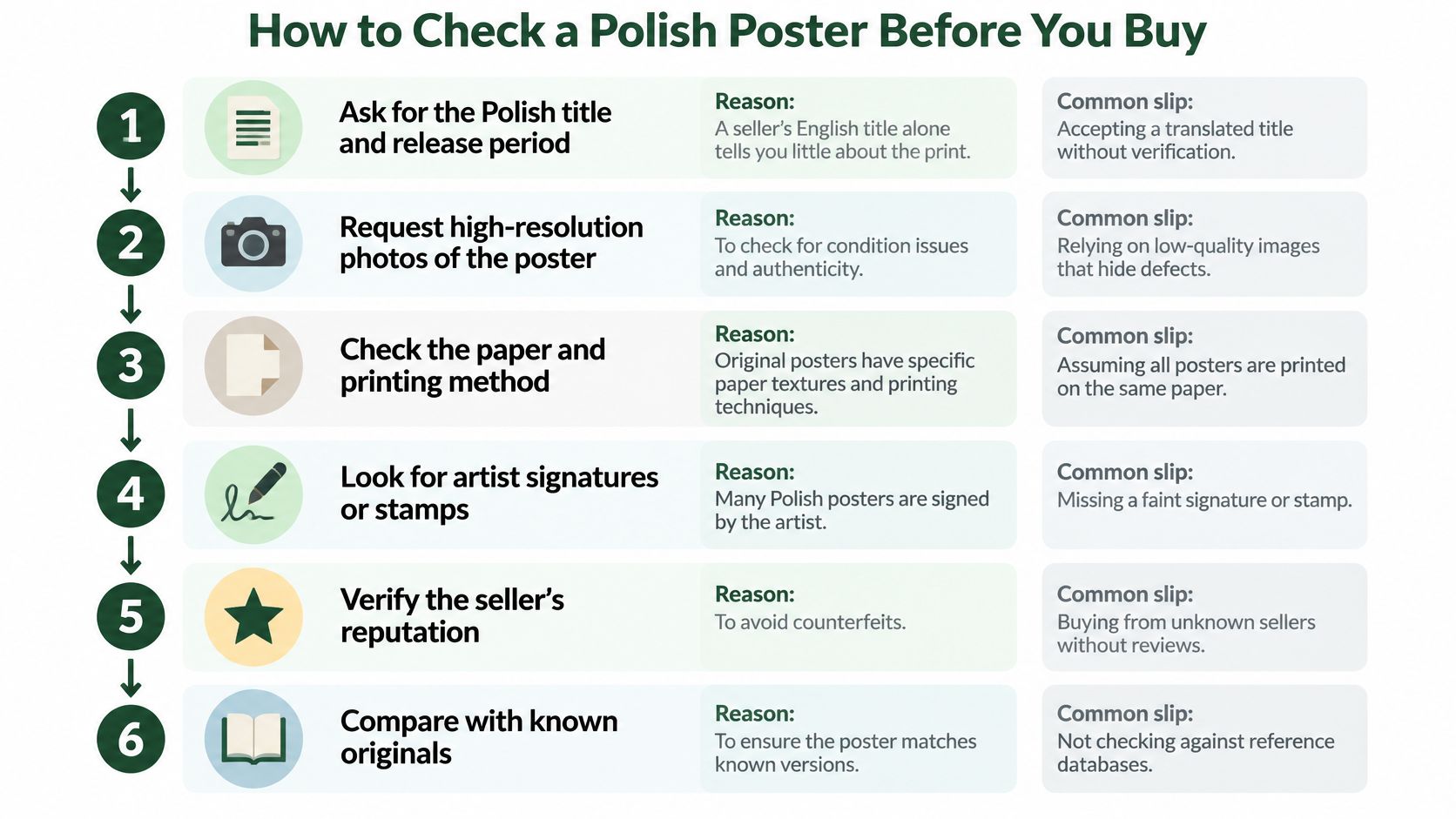
Work through these in order. Each step exists because of a specific mistake buyers make.
- Ask for the Polish title and the release period. An English title in a listing tells you about the film, not the print. A Polish title, with a year, gives you something to check.
- Get the sheet measured flat, in three places. Width and height at the top, middle and bottom. Trimming shows up as inconsistency, so three readings prove more than one.
- Check the paper by feel and under light. Thin stock with a single horizontal fold fits a pre-1977 issue. Thick, stiff, uniform modern stock doesn't, whatever the listing says.
- Look for printer or distributor marks and any credit line. A signature with a date is the best single anchor, as the Raducki example shows. Photograph whatever you find, including what you can't read.
- Examine restoration under raking light. In-painting, backing, edge repair and uneven colour all show at a low angle. Ask for condition photographs taken that way, not a flat scan.
- Request provenance. Previous owner, purchase record, any earlier exhibition or auction history. A paper trail is evidence. An enthusiastic description isn't.
The usual slip is treating a striking design as proof of authenticity. Polish posters were commissioned for imported films and often looked nothing like the British or American campaign, so an inventive image that doesn't resemble the marketing you remember is normal. Resemblance proves nothing in either direction.
The Email to Send Before You Pay
Could you confirm the Polish title, the poster date, the measured dimensions taken flat, the printer or distributor marks, any signature and date, and whether the sheet has been trimmed, backed or restored? Are there photographs of the edges and the back, and do you have any provenance or previous sale record?
Send it to any seller, including us. Our own stock runs to hundreds of posters, searchable by decade, genre or franchise, and we sell only guaranteed original movie posters, so a seller who can't answer the list is a seller worth walking away from.
You can also read more on judging condition and format in our guide to original movie posters in the UK before you start comparing prices.
Buy only when the measured format, the documented history and the condition report all agree.
If you'd rather spend your time choosing a design than policing a listing, Famous Movie Posters sells only guaranteed original movie posters, with free UK shipping and worldwide delivery, and stock held flat in archival conditions rather than rolled in a tube. If a specific title is missing from the catalogue, the Request a Poster service can source it through trusted partners. Start there, measure before you frame, and buy the sheet rather than the story.